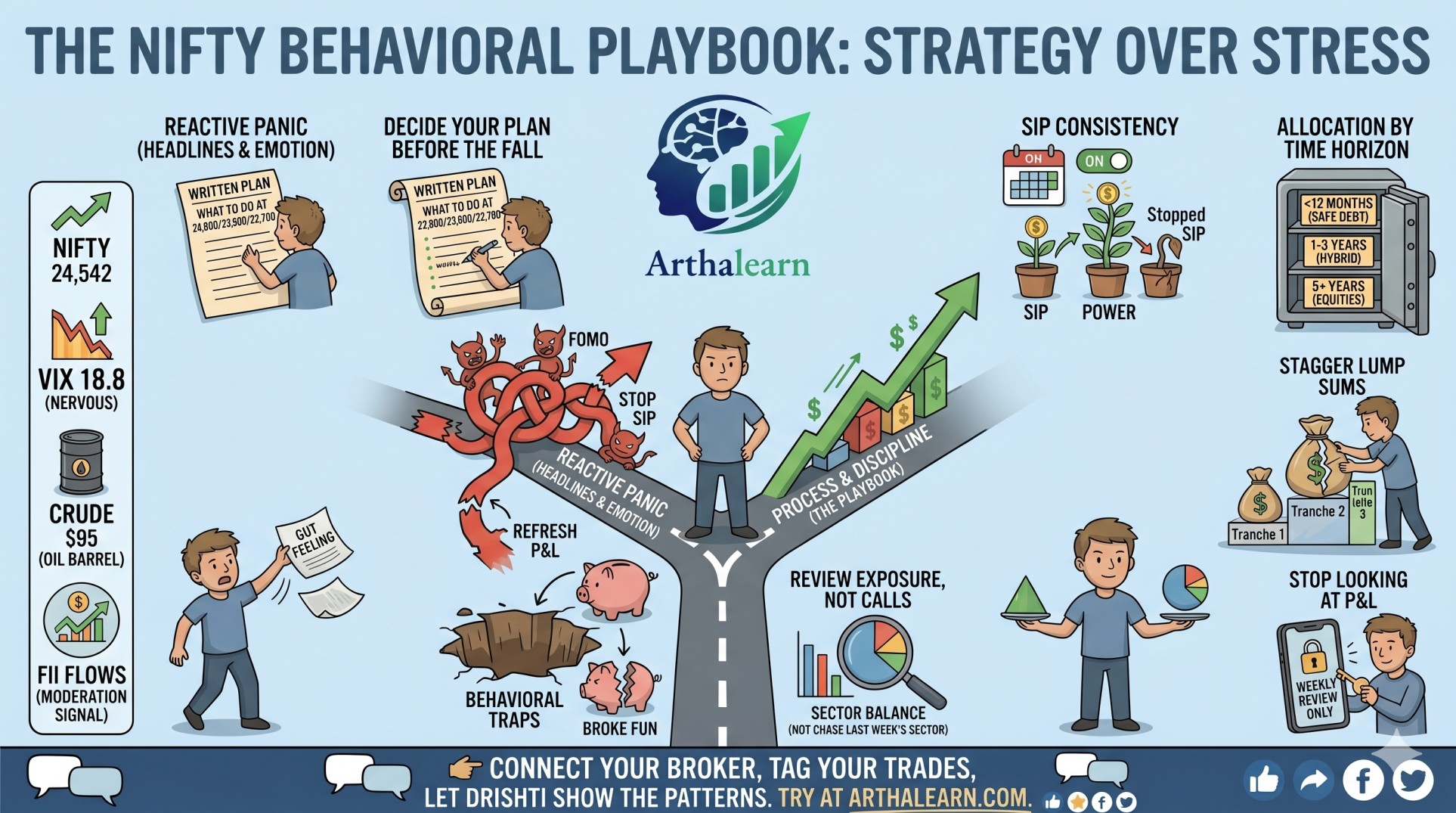
Drawdown Recovery for Indian Traders: A Field-Tested Framework
A clear-eyed framework for working through trading drawdowns in Indian markets — what to cut, what to keep, and how journaling rebuilds conviction without revenge sizing.

The fastest way out of a drawdown is smaller bets and a written log — not bigger bets and revenge entries.
Drawdown is structural, not personal
Indian retail traders take drawdowns personally. The market does not. Drawdowns happen because volatility clusters, regimes shift, and your edge does not stay constant across all conditions. The 2023 SEBI study on F&O retail traders found that roughly nine of every ten retail F&O participants are net loss-makers over the year. That number does not improve when traders trade more; it improves when they trade less, smaller, and with a clearer record of what they did and why.
The recovery problem, then, is not psychological. It is structural. The trader does not need to be calmer. The trader needs to be smaller.
The four-stage drawdown
Treating every drawdown the same way is the first mistake. There are four distinct stages, each with a different right answer.
Stage 1 — Routine variance (1–3% of account). No action needed beyond reading your journal entries from the past week.
Stage 2 — Sustained losses (5–8%). Cut next-trade size by half. Reduce concurrent positions by one.
Stage 3 — Deep drawdown (10–15%). Stop trading for 24 hours. Re-read every trade journal from the drawdown. Re-enter at quarter-size.
Stage 4 — Critical (greater than 15%). Stop trading for the week. The setup is broken — the strategy or the operator, not the market. The fix is process, not bigger bets.
The framework: cut, write, wait, recompound
1. Cut
Halve your next-trade size before you place another order. Not 30% smaller, not 70% smaller — half. The number matters less than the rule. A halved size during drawdown turns a deepening loss into a shallow one and gives the journal time to catch up to the market.
2. Write
Every losing trade during a drawdown gets a written post-mortem before the next trade is placed. Entry trigger. Stop level. What invalidated the thesis. Whether the rule was followed or not. Written stops are far more likely to be respected than mental stops, because writing them down moves them out of the dopamine cycle and into a contract you have to face.
3. Wait
After a stage-3 loss, enforce a minimum 24-hour cool-off. Markets reopen the next day; your discipline does not regenerate that fast. The cool-off is when you re-read the journal. The cool-off is when you decide whether the strategy is broken or just unlucky. Most traders cannot tell the difference inside an hour of a loss.
4. Recompound
Only return to full size after five consecutive trades have respected the rules in your journal — not five winning trades, five rule-following trades. Recovery is built on process compliance, not on P&L. Profitable trades that broke the rules are debt; they will be paid back at the worst possible time.
Why journaling is the single most consistent recovery signal
There is no shortage of academic and practitioner research on the value of trade journals. The mechanism is simple: writing forces you to confront repetition. The same setup, the same emotion, the same outcome — patterns that look unique in the moment become obvious on the page after the third occurrence. The trader who journals notices the pattern by trade five. The trader who does not notices by trade fifty.
This is also why journaling is the cheapest discipline gain available. It costs nothing, scales perfectly, and the only friction is honesty.
Indian-market specifics
F&O sellers in drawdown should drop one strike further OTM and one expiry shorter. The premium drops, but so does the gamma exposure that turns a recoverable loss into a margin call.
Bank Nifty futures and options carry a different recovery dynamic than Nifty 50 — wider stops, shorter holding windows. A drawdown framework written for Nifty positional swings is not the same framework for Bank Nifty intraday.
Equity intraday in drawdown should compress to one or two highest-conviction setups. The temptation to scan more stocks for more chances is the temptation that deepens drawdowns.
MTF and leveraged delivery during drawdown is structurally wrong. Cut leverage to zero or to CNC-only until you are out.
What does NOT recover drawdowns
Doubling size to 'recover faster.' This is the single most common reason a stage-2 drawdown becomes a stage-4 drawdown.
Switching strategies mid-drawdown. The new strategy is unpracticed; the drawdown becomes the testing ground.
Paid Telegram tip channels and 'guaranteed recovery' courses. SEBI does not register educators or tip-providers in any meaningful sense; the operator economics are course fees, not trading P&L.
Trading more hours to 'make it back today.' Time-on-screen is not edge.
Closing
Drawdowns are not the enemy of long-term performance. They are the tuition. The traders who survive them are not the ones who avoid losses; they are the ones who size correctly during them and write down what happened. The framework above is not a fix. It is a route, and the route is shorter than the alternative.
Enjoyed this article?
ArthaLearn is more than articles. Log your trades, get AI-powered analysis, and track your improvement over time — built for Indian traders.
Free forever for trade logging. AI features start at ₹599/month.