If Nifty Dips From Here, What Should You Actually Do?
Nifty sits at 24,353 with 24,000 as the line in the sand. Here is how to position yourself through the dip without making the three mistakes retail investors make every single correction.

A behavioral playbook, not a prediction.

Nifty closed Monday at 24,353. The high was 26,373 in early January. That is roughly 7.7% off the top, with a sharp fall in late February, a bounce from 22,182, and the index now stuck between 24,000 on the downside and 24,500 on the upside. VIX is above 20. FIIs have sold over ₹39,000 crore this month alone. Q4 results are trickling in. Crude is near $100.
So, will Nifty correct further from here? Maybe. The 24,000 level is the one to watch. A clean break below that opens 23,830, then 23,506, then the 22,700 zone. A decisive close above 25,000 would change the script entirely.
But here is the thing most retail investors get wrong: the answer to "will Nifty fall?" is not where your edge lives. Your edge lives in what you do before, during, and after the fall. That is a behavioral question, not a market question.
This post is about the second one.
Why this phase feels harder than it is
In the first half of FY26, Nifty ran from strong domestic flows and steady earnings. The story was clean. Then the West Asia shock hit in late February, FII selling accelerated, the rupee slipped past 93, and crude spiked. Since then, the market has been moving on headlines, not on fundamentals.
When markets move on headlines, most investors do three things in order:
Refresh their portfolio every few hours.
Read twenty contradictory opinions a day.
Make a decision based on whoever was loudest that morning.
None of these are strategies. They are stress responses dressed up as analysis. The market rewards process. Headlines punish reactivity.
What a dip from here could actually look like
Let us separate scenarios from predictions. Scenarios help you prepare. Predictions help you sound smart on Twitter.
Scenario 1: Shallow dip (24,000 holds). Nifty tests 24,000, bounces, and rotates. IT stays weak, financials and cyclicals lead, broader market remains choppy but intact. This is the base case most desks are leaning toward while Q4 earnings play out and the ceasefire holds.
Scenario 2: Medium dip (24,000 breaks, 23,500 holds). A break below 24,000 opens 23,830 and 23,506. This is a ~4% further drawdown from current levels. Uncomfortable but historically normal. Most 5% to 7% intra-year dips feel like the end of the world at the time and look like a blip on the chart a year later.
Scenario 3: Deeper dip (23,500 breaks). A decisive breakdown below 23,500 would likely require a trigger: renewed West Asia escalation, a sharp crude spike above $110, a disappointing earnings cluster, or a credit event somewhere. The 22,700 and then 22,180 zones come into play. Probability is not zero, but it is not the base case either.
Notice what is missing from this framing: a target. You should not be picking a number and betting on it. You should be picking a plan for each scenario and executing it without drama.
How to actually position yourself
This is the part where most blogs tell you to "stay invested, stay diversified." That is not advice. That is a hug.
Here is something more useful. None of this is a stock tip. None of this is a recommendation to buy or sell anything specific. This is a framework for thinking clearly when the market is not behaving.
1. Decide your fall plan before the fall
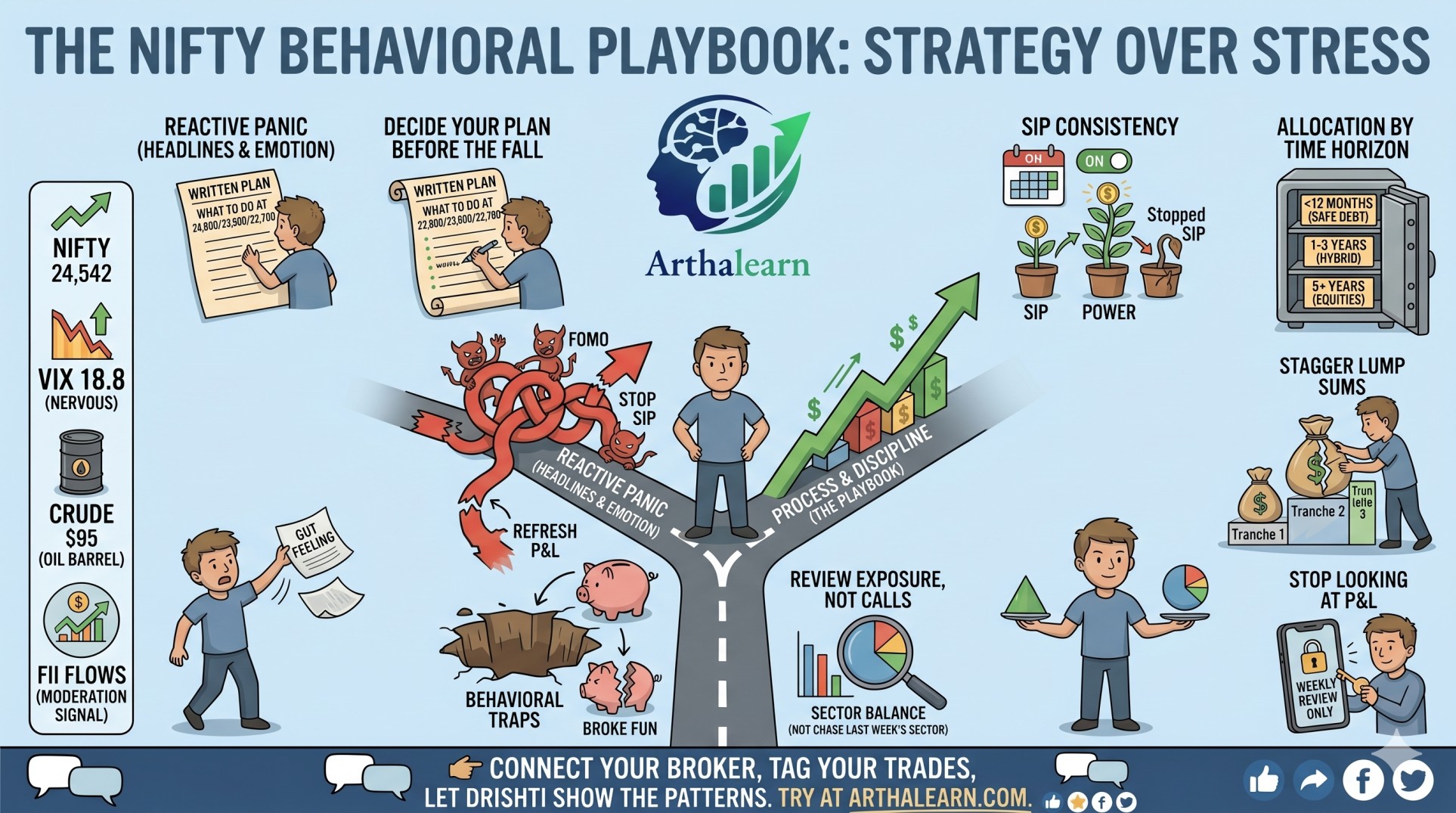
Write down today, on paper, what you will do if Nifty hits 23,800, 23,500, and 22,700. Not in your head. On paper. Cash deployment, rebalancing trigger, which bucket gets topped up first. The point is not that your plan is perfect. The point is that you are deciding with a calm brain instead of a panicked one.
If you cannot answer "what will I do at 23,500?" right now, you will not be able to answer it at 23,500 either. You will just react.
2. Separate your money by time horizon, not by mood
Money you need in the next 12 months should not be in equities. Money you need in 1 to 3 years should be in hybrid or debt. Money you need in 5+ years can ride through a 10% dip without you losing sleep.
Most panic selling happens because short-term money is sitting in long-term instruments. The market did not fail you. Your allocation did.
3. If you are SIP-ing, do absolutely nothing
The single most valuable thing an SIP does is run during corrections. Every rupee you deploy at 23,500 buys you more units than the same rupee at 26,000. Stopping your SIP during a dip is the financial equivalent of turning off the AC to save electricity on the hottest day of the year.
The SIP is a behavioral tool as much as a financial one. Respect it.
4. If you are deploying a lumpsum, stagger it
You do not know where the bottom is. Neither does anyone else. If you have cash to deploy, break it into tranches tied to levels, not to dates. Something like one-third at current levels, one-third at a 3-4% dip, one-third at a 7%+ dip. You will never catch the exact low. You are not trying to. You are trying to get your average cost into a reasonable zone without blowing up.
5. Review sector exposure, not sector calls
This is different from "rotate into banks." Instead, look at your portfolio and ask: am I 60% in IT because I made one call three years ago that happened to work? Am I accidentally concentrated in one theme?
IT has been weak. Financials have been firm. Autos had a strong FY26. Defensives were muted during the recent bounce. These are facts, not forecasts. Use them to check whether your portfolio is balanced, not to chase whichever sector ran last week.
6. Stop looking at your P&L every hour
This one sounds soft. It is not. Checking frequency is directly correlated with bad decisions. The more you look, the more you want to "do something." The more you do, the worse your returns. There is actual research on this. Set a weekly review slot. Close the app the rest of the time.
The trade journaling part nobody talks about
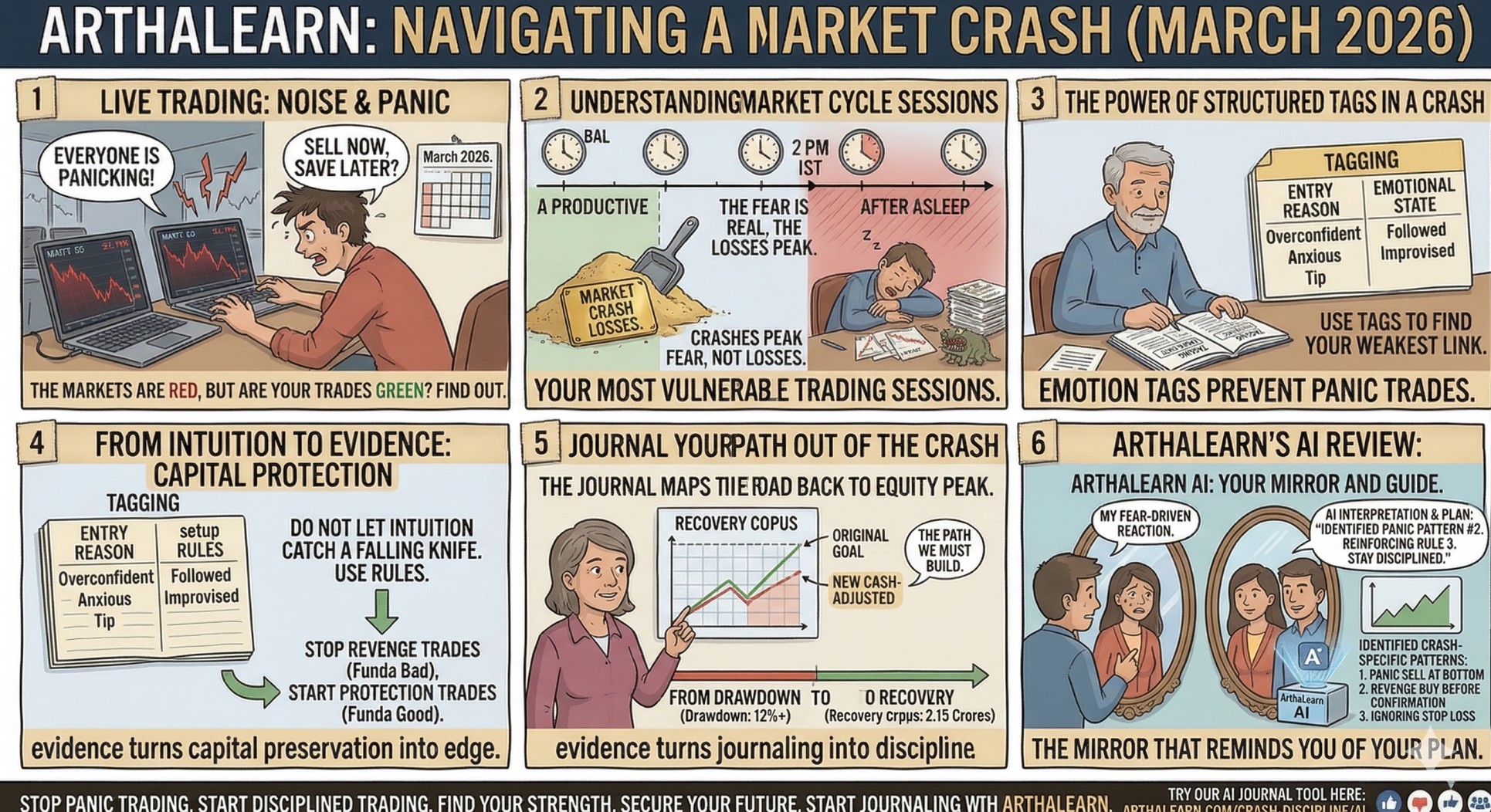
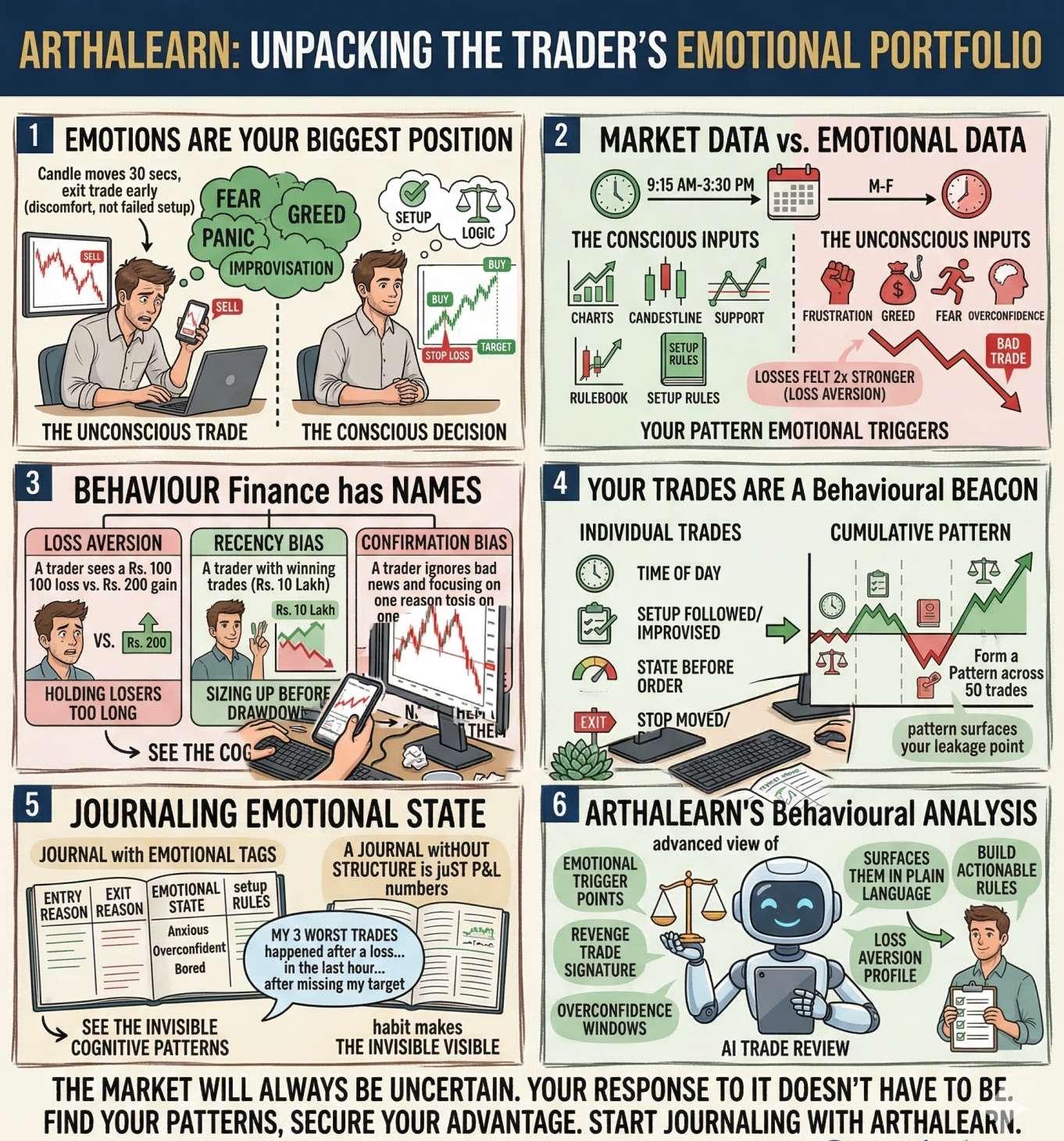
Here is something we see again and again on ArthaLearn: investors remember their wins in detail and forget their losses within a week. That is not laziness. It is a cognitive bias called selective recall, and it is the reason the same person keeps making the same mistake across three market cycles.
If you are not writing down why you bought, what you expected, and what you actually did when the market moved against you, you are not investing. You are just hoping your memory matches your bank statement, and it almost never does.
A dip is the highest-signal period you will get all year. Your real risk tolerance shows up when the market is red, not when it is green. Capture it. Go back and read it next time you are tempted to do something dramatic.
What we are watching at ArthaLearn
Not as a call. As a checklist.
24,000 on Nifty. The line that matters most for the next two weeks.
India VIX. Above 20 means pricing is nervous. Watch for it to cool below 17-18 before assuming stability.
FII flows. Moderation in selling, not a flip to buying, is the first signal. Flip to buying is the second.
Q4 earnings commentary. The numbers matter less than what managements say about FY27.
Crude. Anything above $105 changes the inflation and margin picture fast.
You do not need to act on any of this. You need to not be surprised by any of this.
The point
Markets will do what markets do. You cannot control whether Nifty dips 3% or 8% from here. You can control whether you have a plan, whether your allocation matches your time horizon, whether your SIP keeps running, and whether you are making decisions from a clear head or from a dopamine hit.
Stock tips are not your problem. You are.
Discipline is your edge.
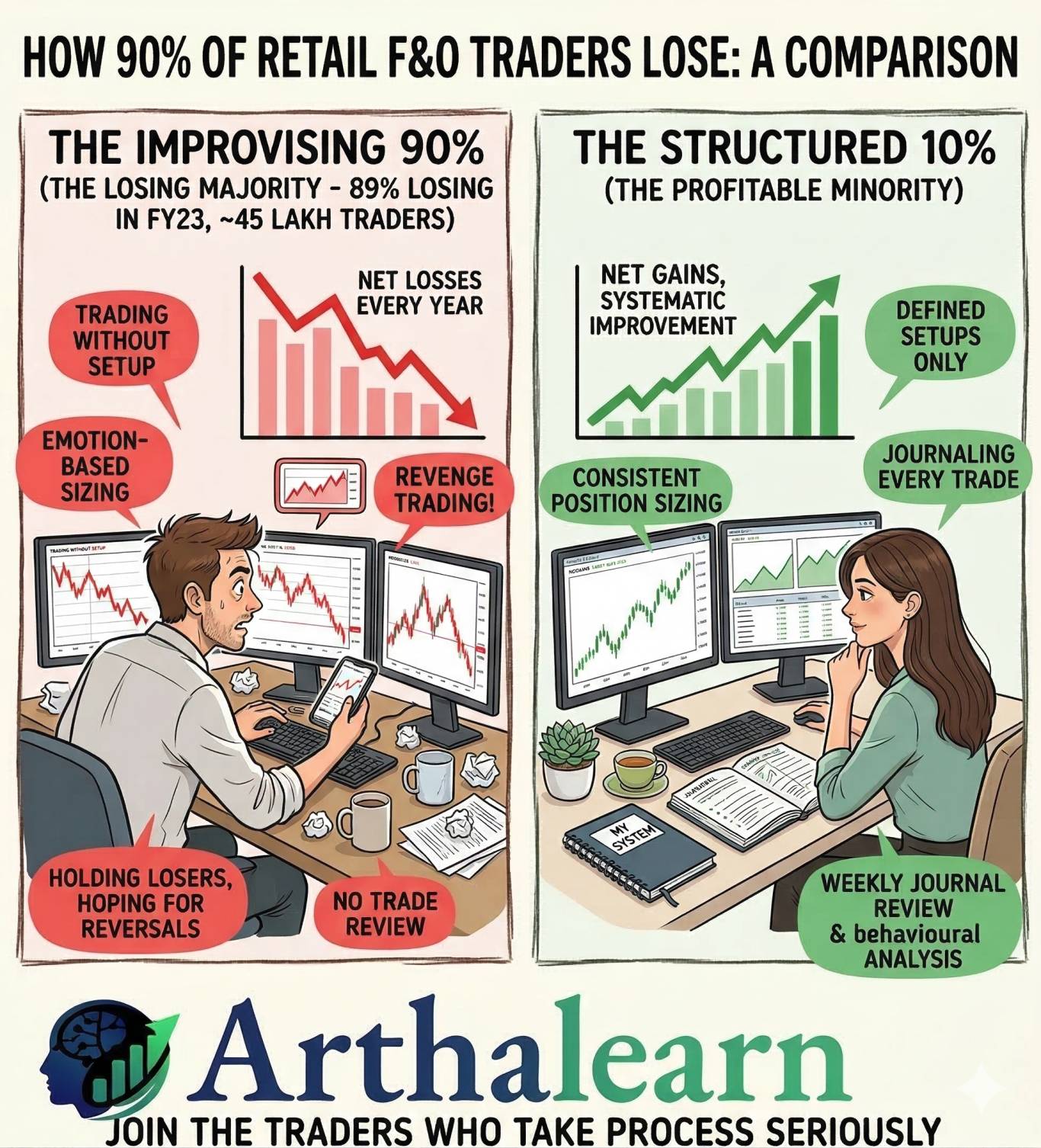
ArthaLearn is a behavioral finance platform, not an investment advisory. We do not recommend stocks. We help you see how you trade, so you can change how you trade. Connect your broker, tag your trades, and let Drishti show you the patterns you have been missing. Try it at arthalearn.com.
Enjoyed this article?
ArthaLearn is more than articles. Log your trades, get AI-powered analysis, and track your improvement over time — built for Indian traders.
Free forever for trade logging. AI features start at ₹599/month.