Market Crash 2026: How to Stay Disciplined During Volatility
Nifty is down 12%+ in 2026. Learn a 5-step framework to stay disciplined, protect capital, and avoid panic selling during market crashes.

Crashes test discipline, not strategy. The traders who journal and follow their plan survive.
The first quarter of 2026 has been brutal for Indian markets. Nifty 50 has shed over 12% from its September 2024 highs, Bank Nifty has corrected even harder, and the mid-cap/small-cap carnage has wiped out months of gains in a matter of weeks. Escalating geopolitical tensions — including the Iran conflict and its ripple effects on crude oil prices — have sent India VIX surging past 20, a level that historically signals sustained turbulence. If you are feeling anxious, confused, or tempted to liquidate everything, you are not alone. But what you do next will define whether 2026 becomes a setback or a turning point in your trading career.
This guide is for every Indian retail trader staring at red screens right now. We will break down what is actually happening, why panic selling destroys portfolios, and give you a concrete 5-step framework to trade through this correction with discipline and clarity. Because here is the truth: crashes test discipline, not strategy. The traders who survive — and eventually thrive — are the ones who journal every trade, follow their plan, and manage their fear and greed like professionals.
What Is Happening in the Markets Right Now?
Let us set the context. As of March 2026, multiple headwinds are converging on Indian equities:
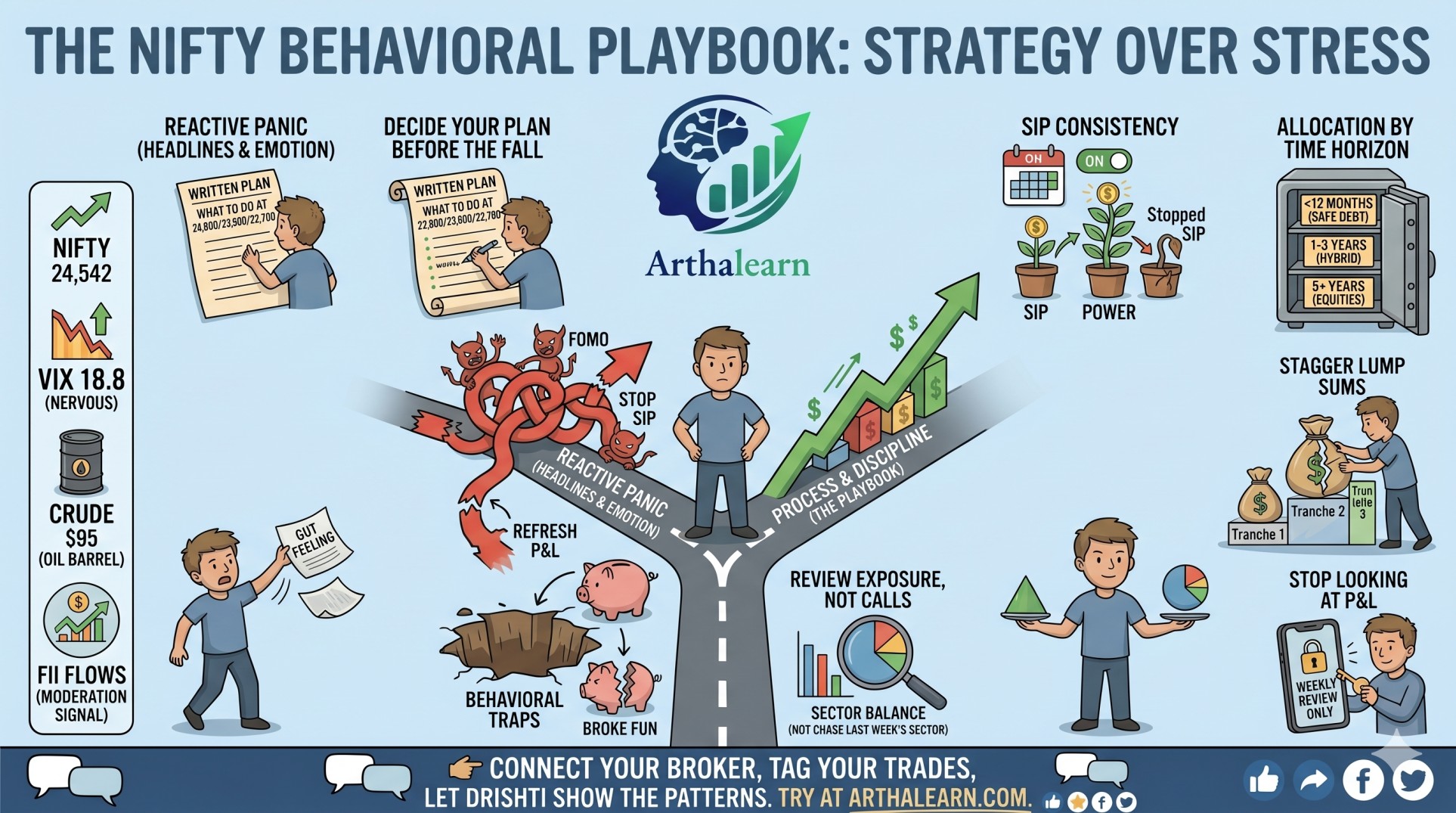
Geopolitical escalation — The Iran-Israel conflict has intensified, with direct military exchanges pushing Brent crude above $95/barrel. India imports over 85% of its oil, so every $10 increase in crude shaves roughly 30-40 bps off GDP growth.
FII exodus — Foreign institutional investors have pulled out over ₹1.2 lakh crore from Indian equities since October 2024, driven by a stronger dollar and higher US yields.
Earnings miss — Q3 FY26 results disappointed across IT, FMCG, and banking. Nifty 50 EPS growth has slowed to single digits for the first time in 8 quarters.
VIX spike — India VIX has been elevated above 18-22 for weeks, making options premiums expensive and intraday trading treacherous.
Regulatory tightening — SEBI's new margin rules and STT hikes (effective April 1, 2026) have added friction for F&O traders.
This is a genuinely difficult environment. But difficult is not the same as unprecedented. History has a clear lesson for us.
Why Panic Selling Destroys Portfolios: Lessons from 2008 and 2020
Every major crash in Indian market history has been followed by a recovery that rewarded patient, disciplined participants. The numbers do not lie:
The pattern is consistent: the maximum damage to a portfolio is not caused by the crash itself, but by the behavioural response to the crash. When you sell at the bottom, you crystallize a temporary drawdown into a permanent loss. Understanding drawdown management is critical during these periods.
A study by Dalbar Inc. has repeatedly shown that the average equity investor underperforms the index by 3-4% annually — almost entirely because of mistimed entries and exits driven by emotion. In India, SEBI data shows that 93% of F&O traders lost money over a 3-year period, with aggregate losses exceeding ₹1.8 lakh crore. The common thread? Poor discipline during volatile periods.
The 5-Step Framework for Trading During a Market Crash
Here is a practical, actionable framework you can implement today. This is not theory — it is what separates the 7% of profitable traders from everyone else.
Step 1: Reduce Position Size Immediately
This is non-negotiable. When volatility spikes, your normal position sizing rules must adapt. If you normally risk 2% per trade, cut it to 1% or even 0.5%. If you trade 3 lots of Bank Nifty options, drop to 1 lot. The goal is survival, not profit maximization.
Why? Because in high-VIX environments, stop losses get hit more frequently, gaps are wider, and slippage is worse. A ₹10,000 stop on a normal day can become a ₹25,000 stop during a crash due to gap-down openings. Reduce size so that even a string of losses does not put your account at risk.
Step 2: Widen Your Stop Losses
Tight stops in volatile markets are a recipe for getting whipsawed. If Nifty is moving 300-400 points intraday (which it has been in March 2026), a 50-point stop loss is noise, not protection. Refer to your stop loss strategies and adjust them for the current environment.
Use ATR (Average True Range) based stops instead of fixed-point stops. If the 14-day ATR on Nifty is 280, your stop should be at least 1x ATR from your entry. Yes, this means wider stops — but combined with smaller position sizes (Step 1), your rupee risk per trade stays the same.
Step 3: Journal Every Single Trade
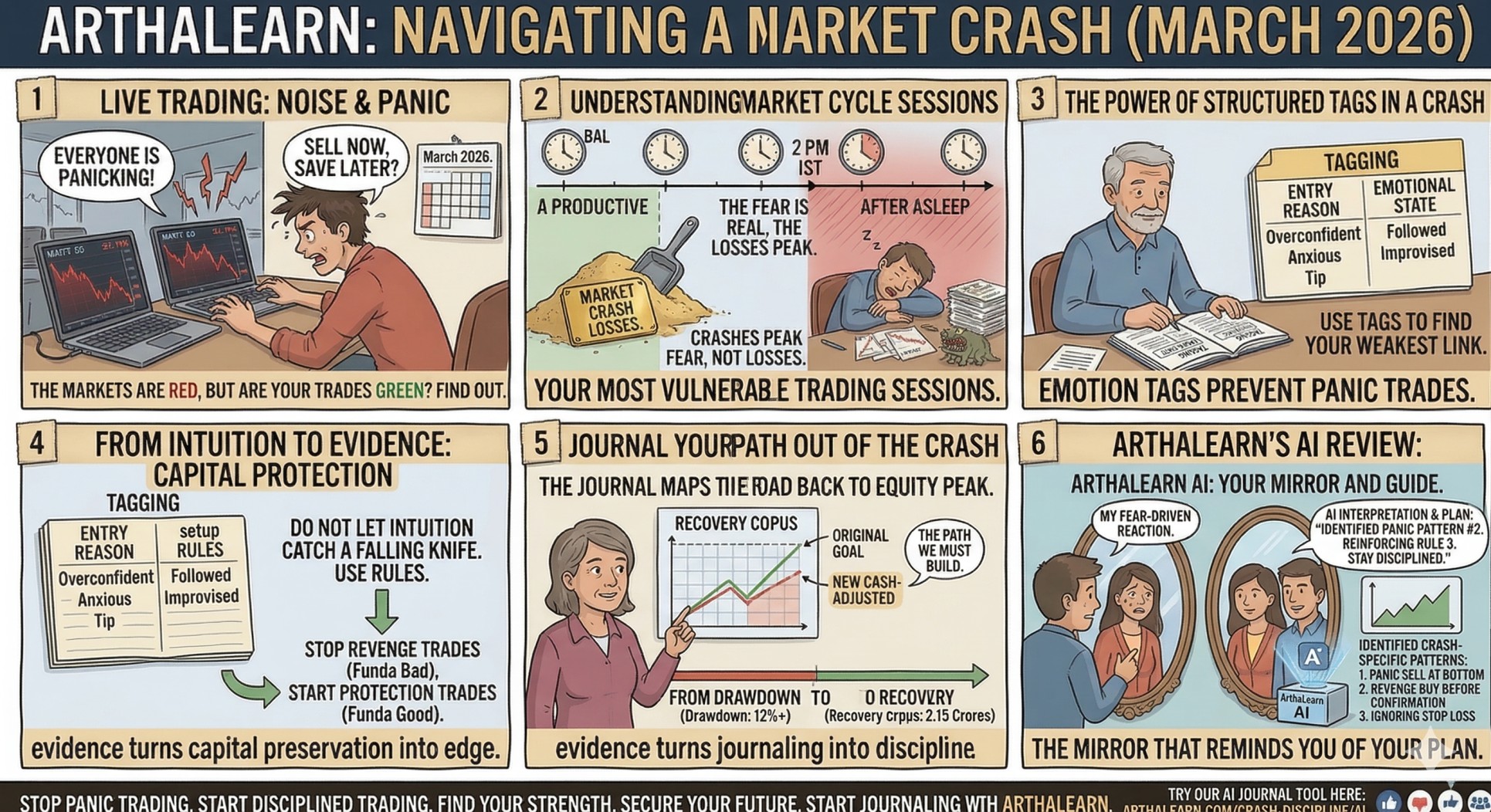
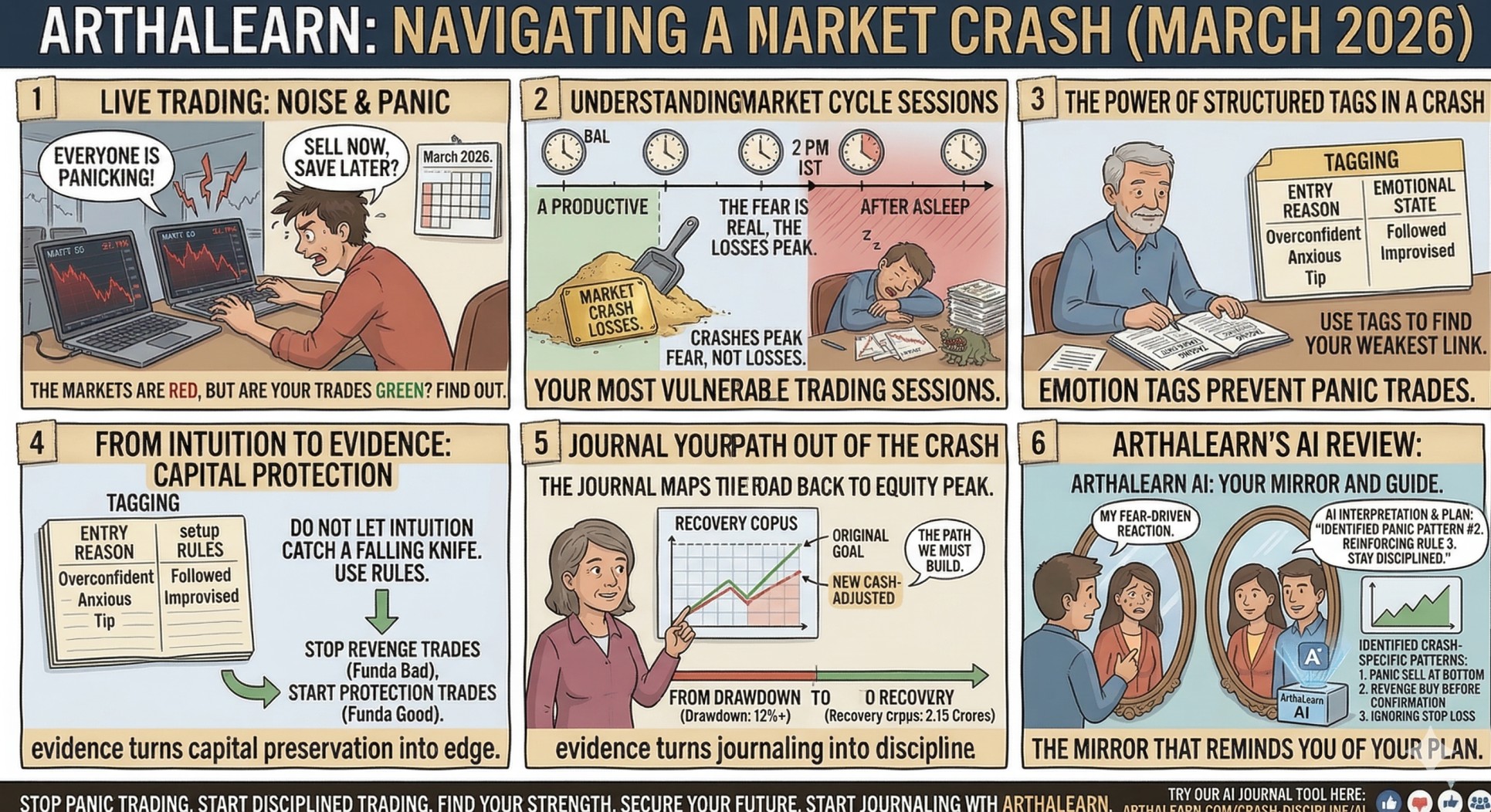
This is where most traders fail during crashes. They stop journaling because the results are painful to look at. But this is precisely when your trading journal matters most. Every trade during a crash is a data point about your behaviour under stress.
Log not just the P&L, but your emotional state before, during, and after the trade. Were you anxious? Were you trying to "make back" yesterday's loss? Were you trading out of boredom? ArthaLearn's trade journal has built-in emotion tracking that lets you tag every trade with your psychological state — and the AI analysis in ArthaLearn's AI will flag patterns you cannot see yourself.
Step 4: Do NOT Revenge Trade
Revenge trading is the single fastest way to turn a bad week into a blown account. It follows a predictable pattern: you take a loss, feel frustrated, immediately enter another trade to "win it back," ignore your rules, take a bigger loss, and spiral. During a crash, this cycle accelerates because losses come faster and the emotional intensity is higher.
The antidote is simple but hard: set a daily loss limit and honour it. If you lose more than 2% of your capital in a single day, stop trading. Close your terminal. Go for a walk. The market will be there tomorrow. Your capital might not be if you keep revenge trading.
Step 5: Wait for Confirmation Before Entering
Crashes create the illusion of opportunity everywhere. "Nifty is down 500 points — it must bounce!" This cognitive bias — anchoring to recent prices — causes traders to catch falling knives. Instead, wait for actual confirmation signals before entering:
A higher low on the daily chart
VIX declining from its peak (not just a one-day dip)
Volume confirmation on a reversal candle
FII flows turning neutral or positive for 3+ consecutive sessions
Missing the exact bottom is fine. Catching a falling knife is not. The first 10-15% of a recovery move is where the smart money enters. You do not need to be first — you need to be right.
How ArthaLearn Helps You Stay Disciplined
We built ArthaLearn specifically for moments like this. Here is how the platform keeps you honest when your emotions are screaming at you to do something rash:
Emotion tracking — Tag every trade with your emotional state. Over time, you will see exactly which emotions lead to your worst trades.
ArthaLearn's AI analysis — Our AI assistant analyses your trading patterns and flags when you are deviating from your plan. It catches revenge trading spirals before they destroy your account.
[Portfolio tracker](/portfolio) — See your real drawdown numbers instead of guessing. Knowing your exact drawdown prevents emotional decision-making.
Daily review prompts — Build trading routines that force you to pause, reflect, and plan before you trade.
The Bottom Line
Market crashes are inevitable. Your response to them is not. The 2026 correction will end — every correction in Indian market history has. The question is whether you will still have capital and confidence when it does.
Reduce size. Widen stops. Journal everything. Never revenge trade. Wait for confirmation. These five steps will not make the red screens disappear, but they will ensure you are still standing when the green returns.
Start building trading discipline today. Your future self will thank you.
Enjoyed this article?
ArthaLearn is more than articles. Log your trades, get AI-powered analysis, and track your improvement over time — built for Indian traders.
Free forever for trade logging. AI features start at ₹599/month.