The Mental Health Cost of Full-Time Trading in India
Trading takes a hidden toll on mental health — isolation, anxiety, burnout, and relationship strain. Learn to recognize the signs, build sustainable habits, and know when to seek help.
Profitable trading means nothing if it costs your health. Build systems, not screen addictions.
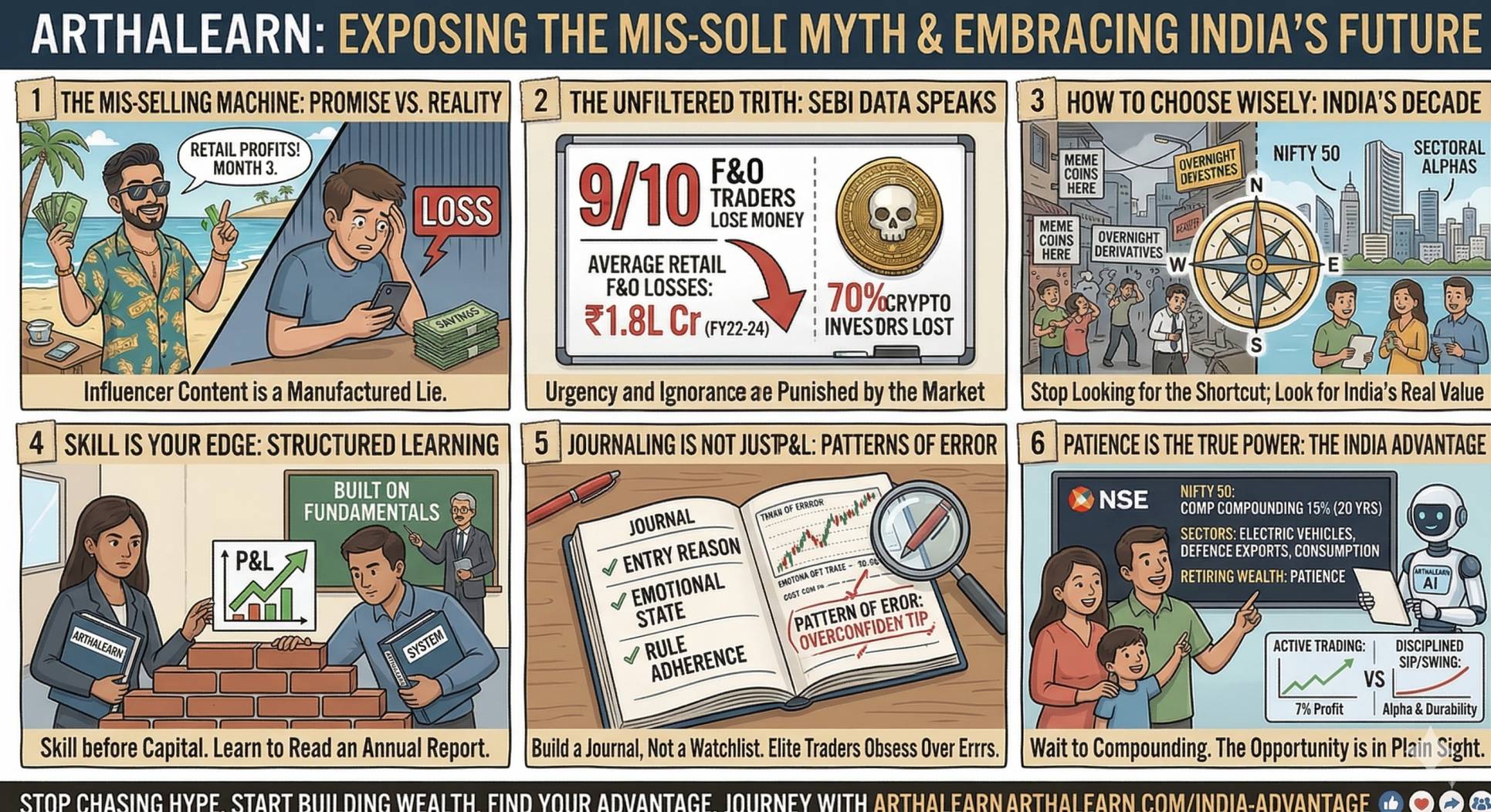
Nobody talks about this. The trading industry sells dreams — financial freedom, work from anywhere, be your own boss. What it does not advertise is the psychological cost: the anxiety that wakes you at 3 AM wondering if your position will gap against you, the isolation of sitting alone in a room staring at charts for 8 hours, the shame of hiding losses from your family.
This article is not about how to trade better. It is about how to live better while trading. Because profitable trading means nothing if it costs your health, your relationships, and your peace of mind.
The Hidden Toll of Full-Time Trading
Trading affects mental health through multiple channels, many of which traders do not recognize until the damage is done:
Isolation
Full-time trading is one of the most isolating professions. You work alone, during hours when friends are at their jobs. Your "colleagues" are anonymous avatars on Telegram. You cannot easily explain what you do — "I trade options" invites either confusion or judgment. Over months and years, this isolation compounds. Many full-time traders report that they have fewer close relationships after 2-3 years of trading than they had before they started.
Screen Time and Physical Health
Active traders spend 6-10 hours per day in front of screens. This leads to eye strain, poor posture, back pain, disrupted sleep (blue light exposure), and reduced physical activity. A study published in the British Journal of Sports Medicine found that sedentary behavior for 8+ hours daily increases the risk of cardiovascular disease by 20%. Trading literally affects your physical heart as well as your emotional one.
Financial Anxiety
When your income is directly tied to market performance — which is inherently uncertain — financial anxiety becomes constant. "Did I make enough this month? Can I pay the bills? What if I have a losing streak?" For traders who support families (especially common in India), this anxiety is amplified. The SEBI data showing ₹2 lakh average annual losses for F&O traders means many traders are losing the equivalent of their previous salary.
Relationship Strain
Trading affects relationships in multiple ways: mood volatility (bad days at "work" come home with you), financial stress shared with partners, reduced quality time (you are always "watching the market"), and the secrecy that often develops around losses. In Indian households, where financial discussions between spouses can already be limited, trading losses become a hidden source of tension.
Identity Crisis
When trading becomes your primary identity, every loss feels like a personal failure. "I am a bad trader" becomes "I am a bad person." This conflation of self-worth with P&L is one of the most psychologically dangerous aspects of full-time trading. It leads to depression, risk-taking to "prove yourself," and an inability to step away even when you should.
The Cortisol Cycle — How Stress Creates More Losses
Stress does not just feel bad — it makes you trade worse. Here is the neurochemical cycle that traps traders:
Loss occurs — Your amygdala triggers a cortisol (stress hormone) release.
Cortisol impairs judgment — Elevated cortisol reduces activity in the prefrontal cortex (rational thinking) and increases activity in the amygdala (emotional reactions). You literally become less rational.
Impaired judgment leads to bad decisions — You revenge trade, overtrade, move stop-losses, or increase position size — all behaviors associated with elevated cortisol.
Bad decisions lead to more losses — The impulsive trades lose money, confirming the stress response and releasing more cortisol.
The cycle repeats — Each loop strengthens the neural pathway, making it easier to trigger next time.
Research by neuroscientist John Coates at Cambridge found that traders' cortisol levels rise during losing streaks and remain elevated even after the market closes. This means the stress comes home with you — affecting sleep, appetite, mood, and relationships.
Recognizing Trading Burnout — 10 Warning Signs
Burnout does not arrive suddenly. It builds gradually over weeks and months. Here are 10 warning signs every trader should watch for:
You dread market open. What used to excite you now fills you with anxiety.
Your sleep is disrupted — either you cannot fall asleep (replaying trades) or you wake up at 4 AM checking pre-market.
You have stopped following your trading plan. Rules feel like a burden, not a framework.
Your risk-taking has increased. Position sizes are growing without a strategic reason.
You feel irritable or emotionally flat outside of market hours.
You have lost interest in hobbies, exercise, or socializing.
You are hiding your trading results from family or friends.
You check your phone for market news compulsively, even on weekends.
Physical symptoms: persistent headaches, back pain, digestive issues, or fatigue.
You have thought "I should quit" more than once this month.
If you recognize 3 or more of these signs, you may be experiencing trading burnout. This is not weakness — it is your body and mind telling you that something needs to change.
Building Sustainable Trading Habits
The goal is not to trade as much as possible — it is to trade sustainably. Here are evidence-based habits that protect your mental health while maintaining performance:
Fixed Trading Hours
Set a firm start and end time. Example: 9:15 AM to 12:30 PM. After 12:30, close your terminal. The first 2-3 hours of the Indian market have the highest volume and the best setups. There is no edge in staring at screens from 12:30 to 3:30 on most days. Build a trading routine that has clear start and stop times.
Daily Exercise — Non-Negotiable
Exercise is the single most effective stress reducer available. A 30-minute walk, run, or gym session reduces cortisol, increases serotonin and endorphins, and improves sleep quality. Schedule it during market hours if needed — perhaps 1:00-1:30 PM when the market is typically quiet. Your health is worth more than one trade.
Social Connections
Make a deliberate effort to maintain relationships outside trading. Schedule weekly meals with friends. Call a family member every day. Join a non-trading activity — a sports league, a book club, a volunteer organization. Human connection is a biological need, and trading isolation deprives you of it.
Hobbies That Have Nothing to Do With Money
Trading is financially scorekeeping every second of the day. You need activities where the outcome is not measured in rupees. Play music, paint, garden, cook, hike. Activities that engage "flow state" — where you lose track of time because you are fully absorbed — are particularly beneficial for mental recovery.
Weekend Detox
Saturday and Sunday should be market-free zones. Do not check pre-market data. Do not scroll through trading Twitter. Do not "prepare for Monday" on Sunday evening. Your brain needs a complete reset. Trading discipline includes the discipline to stop.
Financial Separation
Keep your trading capital completely separate from your living expenses. Never trade with money you need for rent, EMIs, or family expenses. Having a 6-12 month emergency fund that is not in your trading account eliminates the existential dread of a losing streak. When a loss does not threaten your ability to pay bills, it is dramatically less stressful.
How Journaling Protects Your Mental Health
Journaling is not just a trading performance tool — it is a mental health practice. Psychological research consistently shows that expressive writing reduces stress, anxiety, and depressive symptoms. For traders, journaling serves specific mental health functions:
Emotional awareness — Writing "I felt panicked and revenge traded" forces you to acknowledge the emotion instead of suppressing it. Suppressed emotions do not disappear — they compound.
Pattern recognition — Your journal reveals triggers you might not consciously recognize: "I always trade worse after a fight with my wife" or "My losses increase when I skip the gym." These insights are invisible without data.
Accountability — The act of documenting a bad decision creates a psychological deterrent against repeating it. You do not want to write "I revenge traded again" for the fifth time this month.
Progress tracking — On bad days, your journal shows you how far you have come. "I used to revenge trade 3 times per week. Now it is once a month." Progress is motivating, and motivation is a mental health resource.
ArthaLearn's journal is designed with these mental health benefits in mind. Emotion tags, reflection prompts, and pattern analytics make it easy to use journaling as both a trading tool and a wellness practice. Mindfulness in trading and journaling work together to build emotional resilience.
When to Seek Professional Help
There is no shame in seeking professional help. In fact, many institutional trading firms require their traders to work with psychologists. Here are signs that you should speak to a mental health professional:
Persistent anxiety that does not resolve on weekends
Depression — loss of interest in activities you used to enjoy
Sleep disturbances lasting more than 2 weeks
Substance use to cope with trading stress (alcohol, medication misuse)
Suicidal thoughts or feelings of hopelessness
Relationship breakdown directly related to trading behavior
Inability to stop trading even when you know you should (trading addiction)
Resources in India
If you or someone you know is struggling, these resources can help:
NIMHANS Helpline: 080-46110007 (National Institute of Mental Health and Neuro Sciences, Bangalore)
iCall (TISS): 9152987821 (Monday-Saturday, 8 AM to 10 PM) — Free counseling by trained professionals
Vandrevala Foundation Helpline: 1860-2662-345 (24/7, multilingual) — Free crisis support
AASRA: 9820466726 (24/7) — Crisis intervention and emotional support
These helplines are free, confidential, and staffed by trained counselors. There is no judgment. You do not need to be in crisis to call — even if you just need someone to talk to about trading stress, they can help.
The Bottom Line
Trading is one of the few professions where your emotional state directly determines your income. This makes mental health not just important — it makes it essential infrastructure for a trading career.
Build sustainable habits: fixed hours, daily exercise, social connections, hobbies, and weekend detox. Journal not just your trades, but your emotions. Separate your trading capital from your living money. And if you are struggling, seek help — there is no weakness in it, only wisdom.
The most important trading skill is knowing when to stop. Not when the market closes — when you need to close.
Your trading career is a marathon, not a sprint. Protect the runner — yourself — and the results will follow. ArthaLearn helps you build the sustainable, data-driven trading practice that protects both your capital and your well-being.
Enjoyed this article?
ArthaLearn is more than articles. Log your trades, get AI-powered analysis, and track your improvement over time — built for Indian traders.
Free forever for trade logging. AI features start at ₹599/month.