The Dream They're Selling You Is a Lie.
F&O trading and crypto are being aggressively mis-sold to young Indians on the promise of quick profits. Here is what SEBI data actually says, how the mis-selling machine works, and why the Indian market alone is more than enough if you approach it with the right skills and patience.

The market rewards skill and patience. It punishes urgency and ignorance. Nine out of ten F&O traders lose money not because markets are unfair but because they entered without education, without a process, and without understanding the loss mechanisms. Crypto mis-selling follows the same pattern with a different costume. India does not need you to chase exotic instruments or influencer tips. The Indian market, done right, with a journal, a system, structured learning, and genuine patience, is one of the most powerful wealth-building vehicles available to any young person today. Stop looking for the shortcut. The shortcut is the trap.
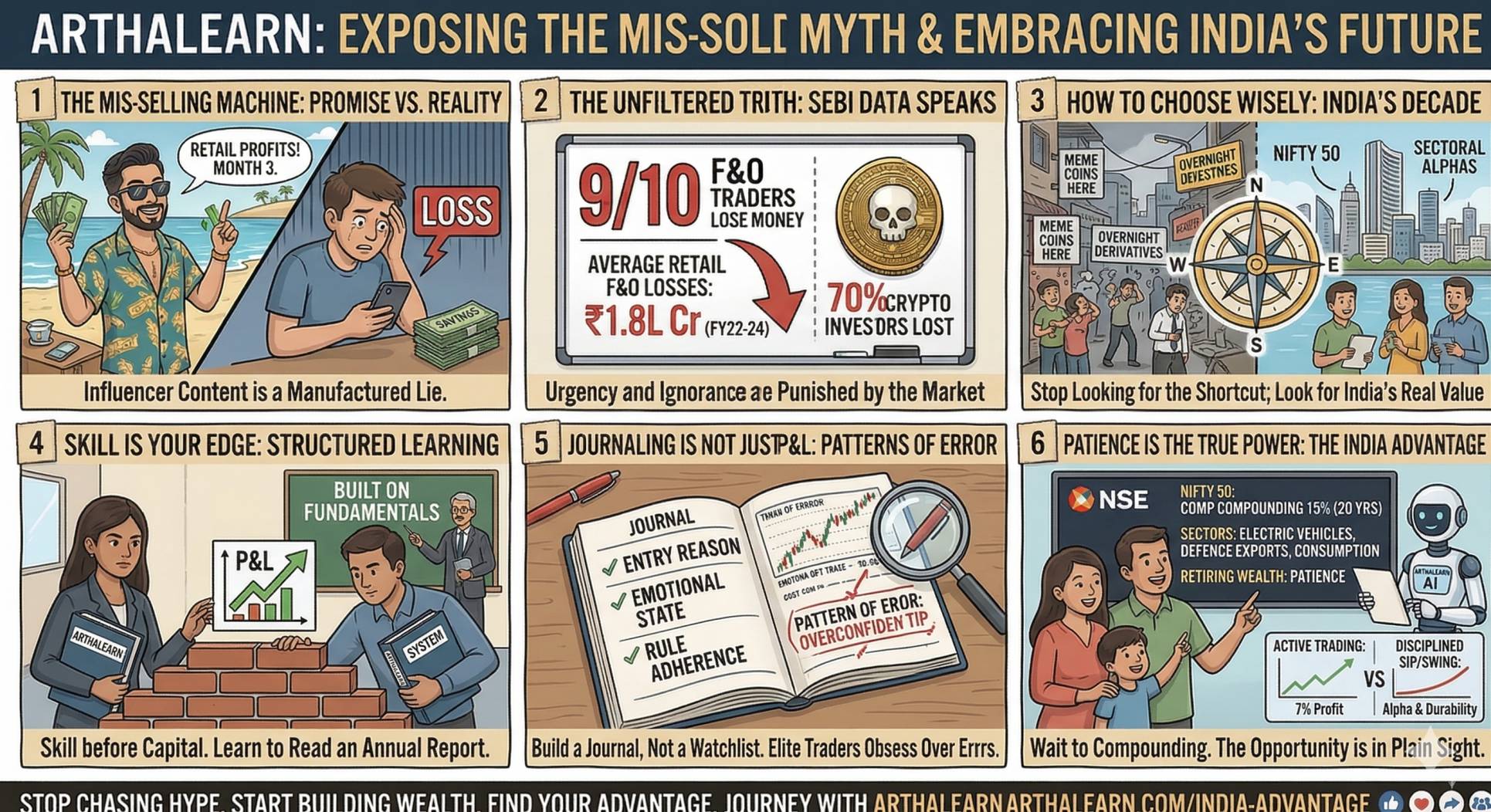
Open Instagram, YouTube, or any trading Telegram group and the pitch is always the same. A screenshot of a brokerage account showing six figures. A lifestyle reel from Bali. A caption that reads: "Started with ₹50,000. This is month 3."
For millions of young Indians between 20 and 35, this content is not entertainment. It is career advice. And that is a disaster quietly unfolding in real time.
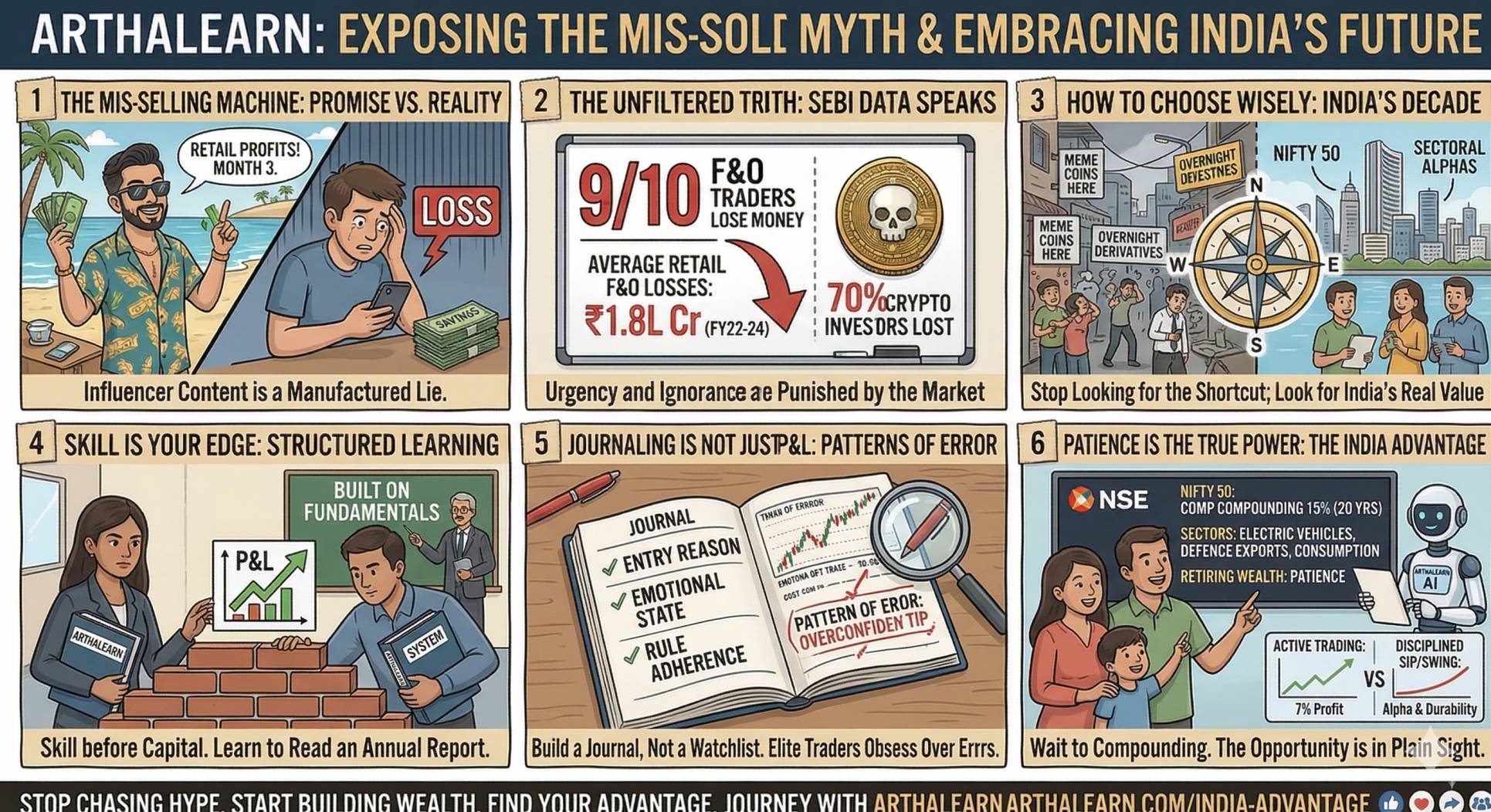
SEBI's own data tells the story nobody wants to tell. Nine out of ten individual traders in the F&O segment lose money. Not most years. Every year, consistently, across the data. The average loss per person is not a rounding error. It is savings. It is borrowed capital. It is occasionally a marriage or a mental health crisis.
Over ₹1.81 lakh crore in net losses were reported by individual traders in the equity F&O segment over just three fiscal years: FY2022 to FY2024. The top 3.5% of active traders accounted for 97% of all net profits. The rest were subsidising the wins of proprietary desks, algorithms, and institutional flow.
Crypto adds its own chapter. The promise of decentralisation became the delivery of concentrated manipulation. Tokens with no underlying business, launched by anonymous teams, promoted by influencers on paid contracts, and dumped on retail buyers within weeks. A generation that didn't trust stock brokers put its trust in Discord servers instead.
How the Mis-Selling Actually Works
The machine is well-engineered. Here is how it operates, and why smart people fall for it.
Survivorship bias as marketing. The 7% who profit in F&O are extremely visible. They have YouTube channels, Twitter followings, and testimonials. The 93% who lost quietly close their trading accounts, feel ashamed, and disappear. You never see their content. The algorithm shows you only the winners, so you believe winning is common.
Complexity disguised as skill. Options Greeks, IV crush, delta hedging. The terminology is sophisticated enough to feel like expertise is being taught. But most course content stops at theory and never addresses risk-adjusted returns, position sizing, or drawdown management. You learn to sound like a trader. Not how to survive as one.
Paper profits, real losses. Many influencers show trades in hindsight or on paper trading accounts. Slippage, brokerage, STT, and the psychological pressure of real capital are conveniently absent. The education happens in a vacuum that doesn't resemble the actual market.
The crypto influencer industrial complex. Token promoters are paid in pre-release allocations, not INR. They are financially incentivised to create FOMO before they exit. The retail buyer enters at peak hype and holds through the dump, often because the same influencer is now running "long-term conviction" content to slow the bleed.
Speed as a feature. The pitch is always about speed. Quick profits. Compounding fast. The language targets young people who are impatient, under financial pressure, and want results now. Long-term wealth building is framed as boring, slow, and a strategy for people without ambition.
Speed is not an edge in markets. It is a vulnerability. The faster you need results, the more risk you will take. And excessive risk, in markets, means capital destruction almost by definition.
What the Right Approach Actually Looks Like
Here is what does not make for viral content but does make for durable wealth.
Skill before capital. No professional field gives you the tools to earn before training you to use them safely. Trading is the only arena where people routinely deploy real capital with zero structured education. The first step for any young market participant is an honest, structured understanding of how markets work, including why most people lose. Understanding the loss mechanisms is more valuable than knowing the winning strategies.
Paper trade long enough to hurt. Not two weeks. Not one month. Paper trade for a full market cycle. Trend, correction, sideways chop. See how your system performs when volatility collapses. See if you still follow your rules when you have eight consecutive losing trades on paper. If you cannot manage paper losses emotionally, real capital will be catastrophic.
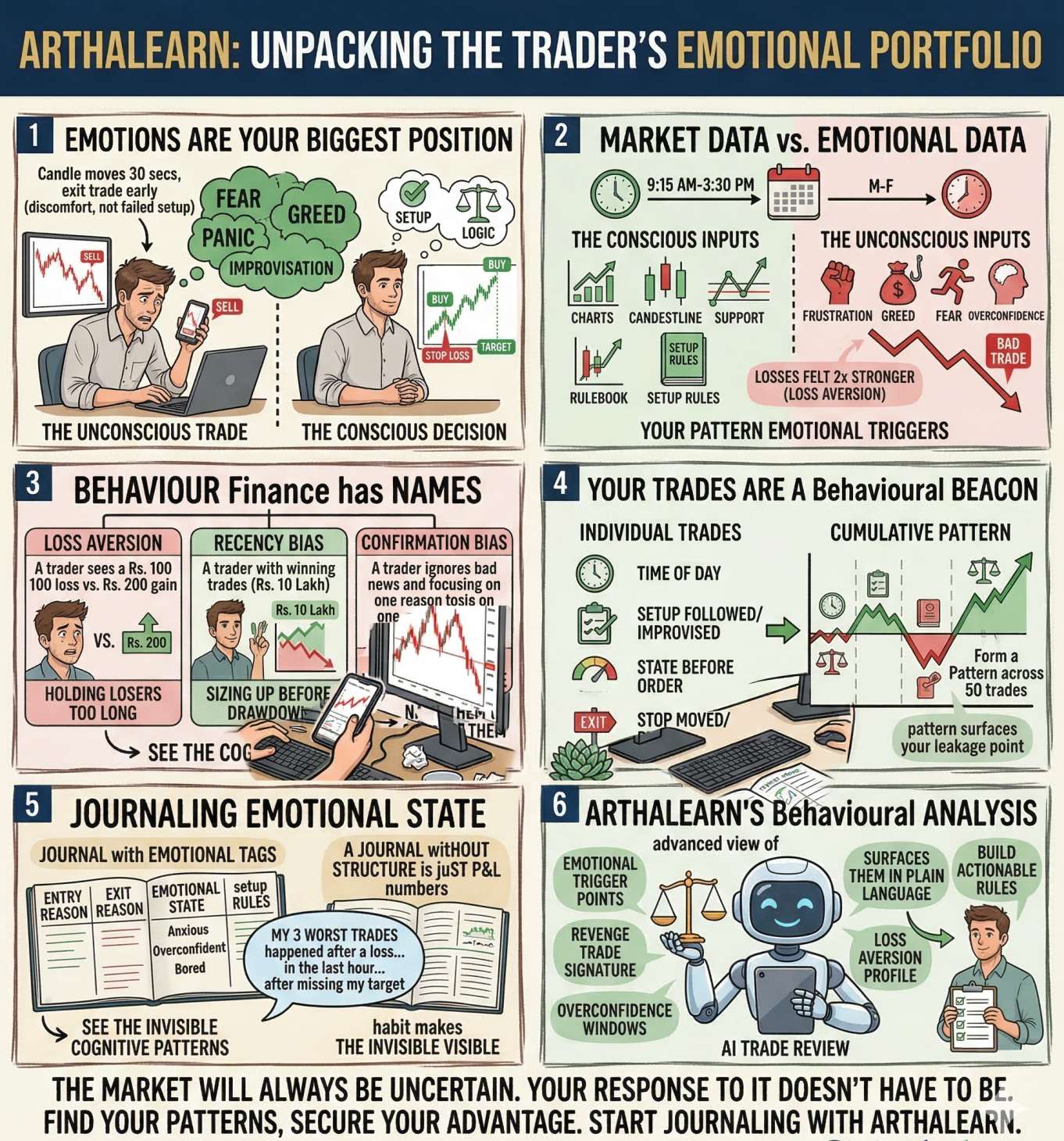
Build a journal, not a watchlist. Most traders obsess over stock selection. Elite traders obsess over their own decision-making. A trading journal that captures not just P&L but your reasoning, your emotional state, and your rule adherence is where real improvement happens. You are not looking for the best stock. You are looking for your own patterns of error.
F&O is a tool, not a product. Options and futures serve genuine purposes: hedging a portfolio, locking in price on physical commodities, expressing a time-bound directional view with defined risk. They are not lottery tickets. Treating them as high-leverage bets on weekly expiry is not trading. It is gambling with a financial instrument as the medium.
Understand crypto for what it is. Blockchain technology has real utility. Some crypto assets have genuine network effects and use cases. But 95% of tokens are speculative instruments with no revenue, no governance, and no accountability. If you participate in crypto, do so with position sizes you are prepared to write to zero, with tokens that have transparent teams, real usage metrics, and on-chain activity you have personally verified.
Indian Markets Are More Than Enough.
Here is something the crypto crowd does not want you to believe: you do not need exotic instruments, foreign exchanges, or leveraged derivatives to build meaningful wealth.
The Indian equity market alone, approached with competence and patience, is one of the great wealth-building opportunities available to any young person right now.
India is in the middle of a decade-long structural expansion: formalisation of the economy, rising household incomes, digital infrastructure buildout, manufacturing shift, and a consumption boom driven by 600 million people under 35. Every major theme of this decade, from electric vehicles to defence exports to specialty chemicals to financial services penetration, is investable directly on NSE and BSE.
The Nifty 50 has compounded at roughly 15% annually over the last two decades. There are over 4,800 listed companies across NSE and BSE. India is on track to become the world's third-largest economy by 2035. The opportunity is not hidden. It is hiding in plain sight, behind the noise of weekly expiry options and meme coins.
A disciplined SIP in a Nifty 50 index fund, started at age 22 and held for 30 years, produces retirement wealth most salaried professionals cannot match with active trading.
Sector rotation across Indian themes like banking, infrastructure, FMCG, and technology, done with research and patience, can generate alpha without leverage or overnight risk.
Swing and positional trading on Indian equities, with proper backtesting, journal discipline, and rule-based entries, is a legitimate edge for those willing to develop it over years, not months.
Weekly options buying with no hedge, no plan, and no journal is not trading. It is a transfer of wealth from retail participants to market makers.
Buying a trending crypto token because a paid influencer posted a target price is not an investment. It is funding someone else's exit.
A Direct Message to Young India in the Markets
You are entering markets at a moment of extraordinary access. Your parents had none of this. The tools, the data, the real-time information flow, and the ability to invest with a few taps on a phone were not available to the generation before you.
That access is both the gift and the trap.
Because access without education is not opportunity. It is exposure. And markets will find every gap in your knowledge and extract capital through it with perfect efficiency.
The market does not owe you a return because you are young, because you need the money, or because you took a risk. It responds only to skill, patience, and capital preservation.
The right relationship with markets is not one of urgency. It is one of compounding, starting with compounding your own understanding before you compound your capital. Read annual reports. Study businesses. Understand why a company earns what it earns. Learn to read a balance sheet the way you read a cricket scorecard: with full context, not just the headline number.
The traders who survive a decade in markets all say the same thing when asked what they wish they had known: they wish they had risked less, learned more, and stayed patient longer. Not one of them wishes they had entered derivatives earlier or held a meme coin longer.
India's markets are a genuine vehicle for wealth creation. The Sensex in 2000 was around 5,000. Today it sits above 75,000. That compounding happened not because people traded options aggressively, but because businesses built value, and investors who understood those businesses held on.
That same story is still being written. You can be part of it. But only if you come to markets as a student first, and a trader second.
Discipline is your edge.
ArthaLearn | arthalearn.com
Enjoyed this article?
ArthaLearn is more than articles. Log your trades, get AI-powered analysis, and track your improvement over time — built for Indian traders.
Free forever for trade logging. AI features start at ₹599/month.