Trading Psychology for Indian Beginners — The Complete 2026 Guide
The ultimate guide to trading psychology for Indian traders. Covers the 6 deadly emotions, cognitive biases, pre-trade routines, journaling, and mindfulness — with Indian market examples throughout.

Master your emotions before mastering charts. Psychology is the 80% that determines results.
Ask any consistently profitable trader what separates winners from losers, and the answer is almost never "a better indicator" or "a faster data feed." The answer is psychology. Trading psychology accounts for roughly 80% of trading success — strategy, risk management, and market knowledge make up the remaining 20%.
This guide is written specifically for Indian traders — from the NSE/BSE context to the SEBI data, from BankNifty expiry days to the cultural pressures unique to trading in India. Whether you are a complete beginner or an experienced trader who keeps making the same mistakes, this comprehensive guide will help you understand why you trade the way you do and how to change it.
Part 1: The 6 Deadly Trading Emotions
Every trading mistake can be traced back to one of six emotions. Understanding them is the first step to controlling them.
1. Fear — The Profit Killer
Fear manifests in two destructive ways: fear of loss (not entering trades that meet your criteria) and fear of giving back profits (exiting winners too early). The Indian trader who watched Nifty crash 10% during COVID in March 2020, then missed the entire 100%+ recovery because of fear, knows this emotion intimately.
How it looks: You see a perfect setup — strong support, good volume, favorable risk-reward. But you hesitate. "What if it drops?" You wait. The stock moves 3% in your predicted direction. You never entered. Or worse — you enter, the stock dips 0.5% (well within your stop), and you panic-exit, only to watch it rally 5%. Learn to manage fear and greed with systematic rules.
The fix: Pre-define your entry, stop-loss, and target before the market opens. When the setup triggers, execute mechanically. Fear thrives in ambiguity; clarity kills it.
2. Greed — The Account Destroyer
Greed is what turns a profitable trade into a losing one. You are up ₹8,000. Your target was ₹6,000. But the stock is still moving. "Maybe it will go to ₹15,000." You hold. It reverses. You give back all ₹8,000 and exit at breakeven — or worse, at a loss.
Indian context: The BankNifty weekly expiry is a greed amplifier. Options that are up 200% tempt traders to hold for 500%. The rapid time decay of weekly options means those 200% gains can evaporate in minutes.
The fix: Set profit targets before entering. Use trailing stop-losses. And remember the trading maxim: "Nobody ever went broke taking profits."
3. FOMO — Fear of Missing Out
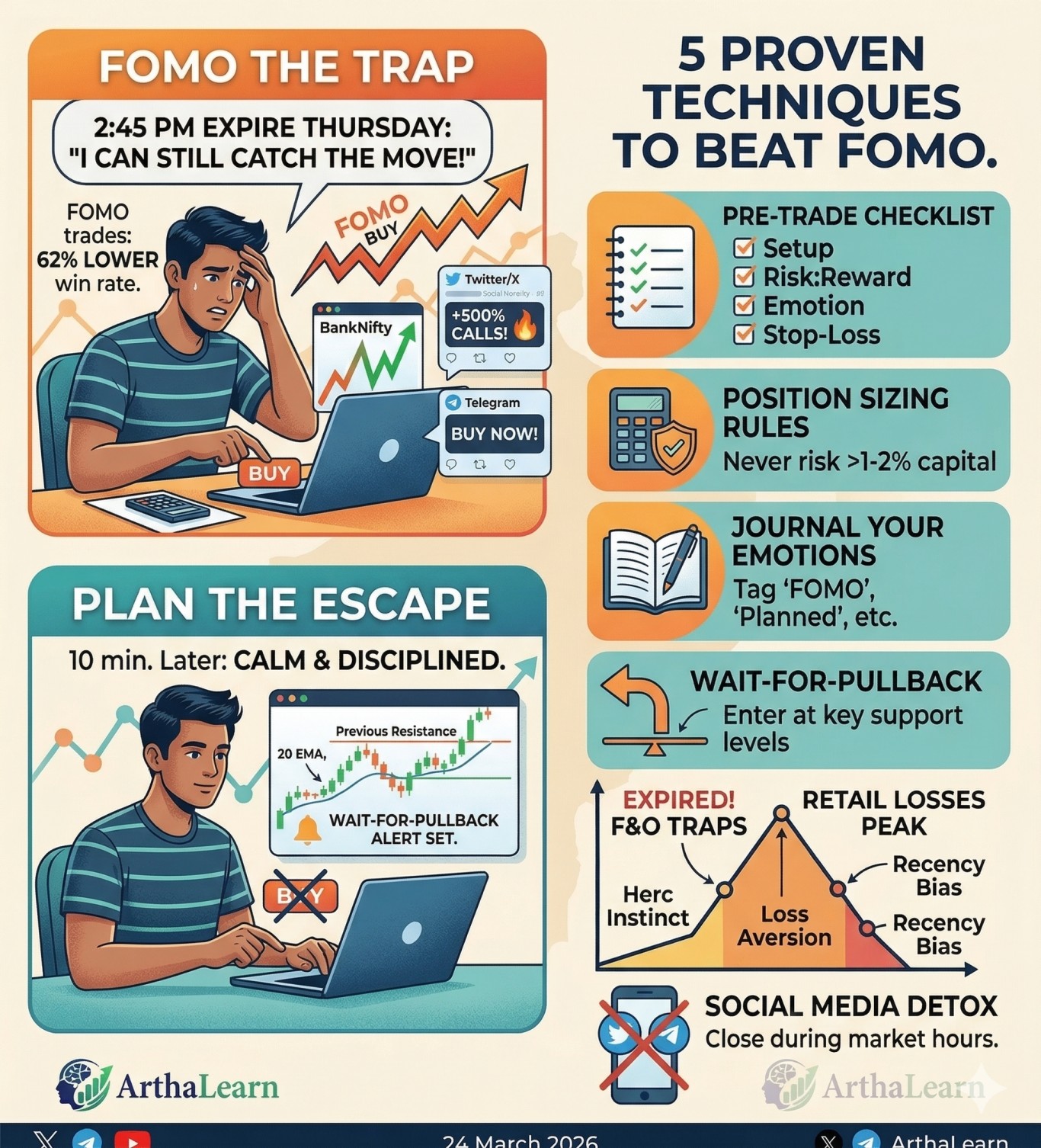
FOMO drives you to enter trades you did not plan, at prices you did not analyze, with sizes you did not calculate. It is the most common emotional trigger for retail traders in India, especially during rally phases or IPO mania.
Indian example: During the 2023-2024 SME IPO frenzy, retail investors applied to every IPO regardless of fundamentals. Many SME stocks crashed 50-80% within months of listing. The traders who bought on listing day, driven by FOMO, bore the worst losses.
The fix: Pre-trade checklists, wait-for-pullback rules, and social media detox during market hours. Read our detailed guide: FOMO Trading — Why Indian Traders Buy at the Top.
4. Revenge — The Spiral Trigger
Revenge trading is the attempt to immediately recover a loss by taking another trade — usually bigger, with less analysis. It is the #1 account killer for F&O traders. A ₹5,000 planned loss becomes a ₹50,000 actual loss in a single session.
Indian context: With BankNifty lots at just ₹15,000-20,000 margin, it is dangerously easy to "add one more lot" after a loss. The low barrier to entry in Indian F&O markets makes revenge trading more accessible — and more destructive.
The fix: Daily loss limits, mandatory 30-minute pauses after losses, and journaling the urge. Full breakdown: Revenge Trading — The #1 Account Killer.
5. Hope — The Silent Bleed
Hope is the emotion that keeps you in a losing trade long after your stop-loss should have been triggered. "It will come back." "The market is just shaking out weak hands." "I'll average down here."
Indian example: Traders who bought Yes Bank at ₹200 and held it down to ₹12, averaging down the entire way, were not trading — they were hoping. Hope turns stop-losses into suggestions and risk management into a wish.
The fix: Treat stop-losses as non-negotiable. Set them at order entry and do not modify them. A stop-loss hit is not failure — it is risk management working as designed. Read about effective stop-loss strategies.
6. Regret — The Backward-Looking Trap
Regret is the emotion that makes you focus on trades you should have taken (or not taken) instead of the next opportunity. "I could have made ₹50,000 if I had just held that Reliance call." "Why did I sell Tata Motors at ₹600 when it went to ₹900?"
Regret is backward-looking and therefore entirely useless for trading. You cannot change the past. But regret changes your future behavior — it makes you hold too long (to avoid regret of selling early) or chase entries (to avoid regret of missing out). This creates a feedback loop with FOMO and hope.
The fix: Journal every trade and extract the lesson, not the regret. Instead of "I should have held," write "Next time I see this pattern, I will trail my stop instead of exiting at target." Forward-looking review eliminates regret.
Part 2: Cognitive Biases That Destroy Trading Accounts
Beyond the six emotions, four cognitive biases systematically distort your decision-making. These are not emotions — they are structural flaws in human reasoning that affect every trader, regardless of experience.
Confirmation Bias
You are bullish on Infosys. You search for "Infosys buy signals" and find 5 articles supporting your view. You ignore the 3 articles showing bearish divergence. This is confirmation bias — the tendency to seek information that confirms what you already believe.
The fix: Before every trade, actively look for reasons not to take it. What is the bear case? Where could you be wrong? If you cannot find a reasonable counter-argument, your analysis is probably incomplete.
Recency Bias
Recency bias causes you to overweight recent events. If BankNifty has rallied for 3 days, your brain predicts it will rally on day 4. If you have had 3 losing trades in a row, you feel like a failure, even if your monthly record is profitable.
The fix: Review your performance over 50-100 trades, not the last 3. ArthaLearn's analytics shows rolling performance to counteract recency bias.
Anchoring Bias
You bought HDFC Bank at ₹1,700. It drops to ₹1,500. Your brain anchors to ₹1,700 as the "correct" price, making ₹1,500 feel like a bargain. So you average down. But the stock does not care about your entry price — ₹1,500 might be the start of a decline, not the bottom.
The fix: Make trading decisions based on current market conditions, not your entry price. Ask: "If I had no position, would I buy here?" If no, it is time to exit.
Sunk Cost Fallacy
You have been holding a losing position for 3 months. You have "invested" time, emotional energy, and capital. Selling now would mean "wasting" all of that. So you hold on, hoping for recovery. But the time and money already spent are gone regardless of what you do next. The only question is: what is the best use of your remaining capital right now?
The fix: Evaluate every open position as if you just discovered it today. Would you enter this trade at the current price, with the current market conditions? If not, exit.
Part 3: Building a Pre-Trade Routine
Professional traders do not just "open their laptop and start trading." They follow a structured pre-trade routine that prepares their mind and eliminates emotional decision-making. Here is a template you can adapt:
The Night Before (15 minutes)
Review tomorrow's economic calendar (RBI policy, US Fed, earnings)
Mark key support/resistance levels on Nifty, BankNifty, and 3-5 watchlist stocks
Write down your trading plan: which setups you are looking for, max trades, daily loss limit
Morning (9:00 AM – 9:15 AM)
Check SGX Nifty / GIFT Nifty for gap direction
Review any overnight news that changes your thesis
5-minute breathing exercise (see Part 6 on mindfulness)
Set your daily loss limit and trade count limit in your journal
Post-Market (15 minutes)
Log all trades in your ArthaLearn journal with emotion tags
Rate each trade: A (perfect execution), B (good but improvable), C (emotional/impulsive)
Write 1 lesson learned from the day
Review your portfolio analytics for any emerging patterns
Part 4: Why Journaling Is Non-Negotiable
A trading journal is not a trade log. A trade log records what happened. A journal records why it happened — what you were thinking, feeling, and planning at the time of each trade.
Here is what journaling does that no other tool can:
Emotional awareness — You cannot fix what you do not see. Journaling forces you to name your emotions, which is the first step to managing them.
Pattern recognition — After 50-100 trades, your journal reveals patterns invisible in real-time: "I always overtrade on Fridays." "My worst trades happen between 2-3 PM." "I lose money every time I hold through earnings."
Accountability — Writing down "I revenge traded after a loss" is uncomfortable. That discomfort is the point. It creates a psychological cost for impulsive behavior.
Evidence-based improvement — Instead of guessing what is going wrong, you have data. Filter your journal by emotion tag, time of day, setup type, or position size — the answers emerge from the data.
ArthaLearn automates the tedious parts of journaling (import trades via CSV or broker API, calculate P&L, chart performance) so you can focus on the reflective parts — the part that actually changes behavior.
Part 5: Building a Trading Support System
Trading is isolating. You sit alone in front of a screen, making decisions that have real financial consequences, with nobody to talk to. This isolation amplifies every negative emotion — fear, revenge, FOMO — because there is no external perspective to counter your internal narrative.
Here is how to build a support system:
Find an accountability partner — A fellow trader who you can call when you are about to make an impulsive decision. The rule is simple: before any trade that does not meet your checklist, call your partner first.
Join a quality trading community — Not a "tips" group. A community focused on process, journaling, and improvement. The difference between a good and bad trading community is whether they celebrate P&L or process.
Consider a mentor — An experienced trader who has been through the emotional cycles and can help you recognize patterns in yourself that you cannot see.
Do not neglect relationships outside trading — Your spouse, family, and friends are crucial anchors. If trading is your only source of identity and self-worth, every loss becomes a personal crisis.
Part 6: Mindfulness and Meditation for Traders
This is not "woo woo" advice. Research published in the Journal of Behavioral Finance shows that traders who practice mindfulness make fewer impulsive trades, hold winners longer, and have lower stress-related cortisol levels. Mindfulness in trading is a competitive edge.
Here is a simple 5-minute practice for before market open:
Sit comfortably. Close your eyes.
Breathe in for 4 counts, hold for 4, out for 6. Repeat 5 times.
Mentally rehearse your trading plan: your setups, your stops, your targets.
Visualize yourself not taking a trade that does not meet your criteria. Feel the calm of discipline.
Set an intention: "Today I follow my plan. Results are secondary to process."
This takes 5 minutes and costs nothing. Traders who practice it consistently report significant improvements in emotional control and decision quality.
Part 7: Essential Reading for Trading Psychology
If you are serious about mastering trading psychology, these five books are essential:
Trading in the Zone by Mark Douglas — The foundational text on trading psychology. Explains why probabilistic thinking is the key to consistent profits.
Thinking, Fast and Slow by Daniel Kahneman — Not a trading book, but the most important book on human decision-making ever written. Understand System 1 (fast, emotional) and System 2 (slow, rational) thinking.
The Daily Trading Coach by Brett Steenbarger — Practical, daily exercises for building psychological resilience. Perfect for Indian traders who want actionable steps.
Atomic Habits by James Clear — Not about trading, but about building habits. Your trading routine is just a collection of habits. This book shows you how to build good ones and break bad ones.
The Psychology of Money by Morgan Housel — Brilliant exploration of how emotions shape financial decisions. Short chapters, Indian examples, highly readable.
Putting It All Together
Trading psychology is not a soft skill. It is the skill. The best strategy in the world is worthless if you cannot execute it consistently — and consistent execution is 100% a psychological challenge.
Here is your action plan:
Identify which of the 6 emotions affects you most. Be honest.
Start journaling every trade with emotion tags — today, not tomorrow.
Build a pre-trade routine and follow it for 30 days without exception.
Find an accountability partner or join a process-focused community.
Try the 5-minute mindfulness practice before market open for one week.
The SEBI data is clear: 93% of F&O traders lose money. The 7% who win are not smarter — they have better systems, better habits, and better emotional control. Psychology is the 80% that determines results. Master it, and the profits will follow.
The market is a device for transferring money from the impatient to the patient. — Warren Buffett
Start building your psychological edge with ArthaLearn. Track emotions, identify patterns, and build the discipline that separates the 7% from the 93%.
Enjoyed this article?
ArthaLearn is more than articles. Log your trades, get AI-powered analysis, and track your improvement over time — built for Indian traders.
Free forever for trade logging. AI features start at ₹599/month.