Building a Bulletproof Risk Management System: Lessons from Market Legends
Discover essential risk strategies from legends like Soros and Dalio to protect your capital and excel in trading without unnecessary gambles. Get step-by-step guides on position sizing, stop-loss protocols, and diversification, plus free templates to implement a resilient system today.

Risk management is not about avoiding losses — it is about ensuring no single loss can take you out of the game.
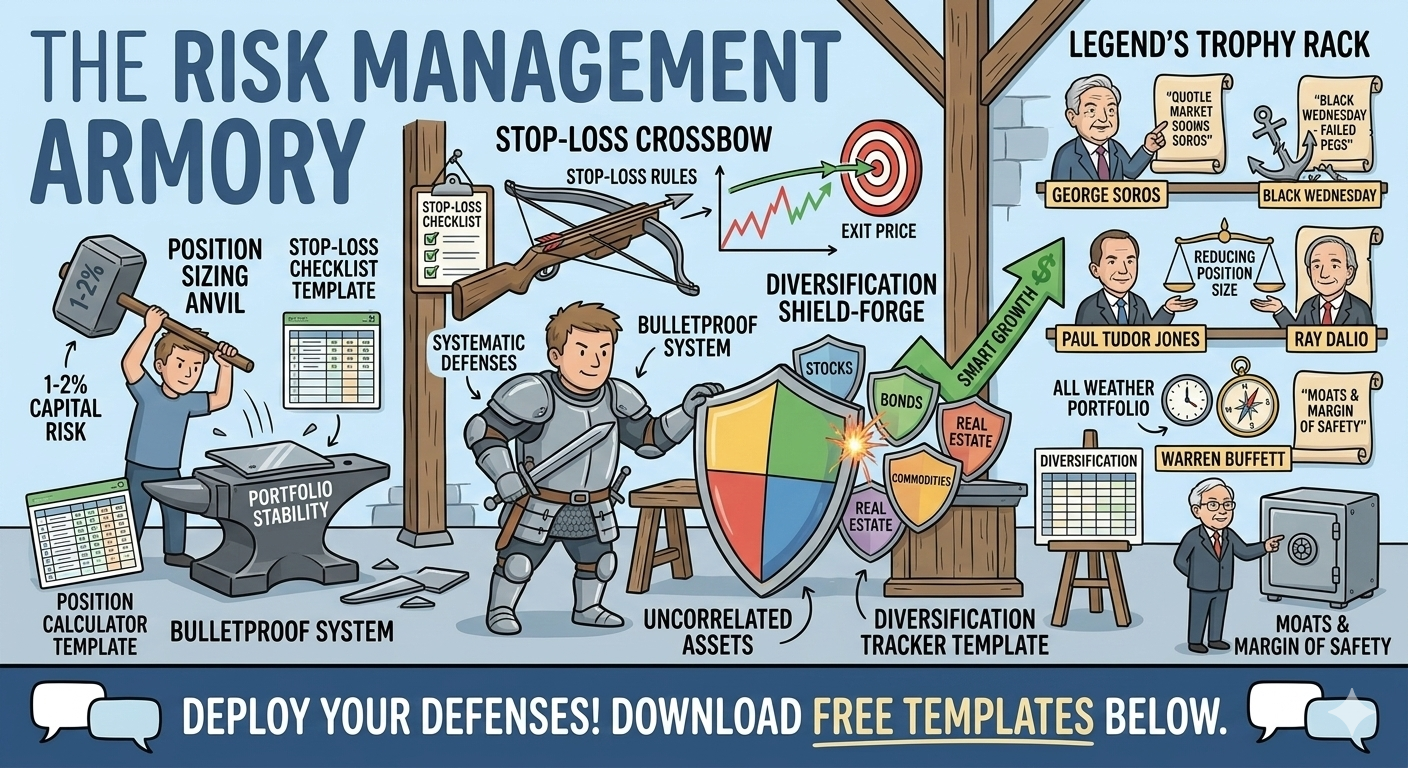
In the fast-paced world of trading and investing, what really sets the pros apart from the amateurs is not smarts or good fortune. It is solid risk management. Skip building a strong system to protect your money, and even your best market ideas could end in disaster. We have seen countless accounts wiped out by folks who went after big wins without watching their backs. But icons like George Soros, Paul Tudor Jones, Warren Buffett, and Ray Dalio did not just hang in there. They built empires by making discipline real with practical tools. In this piece, we will unpack key tactics like position sizing, stop-loss rules, and spreading your bets. You will get easy steps, stories from the greats, and free templates to craft your own unbreakable setup. Keep your capital safe while still chasing smart growth, and see your skills level up.
Why Risk Management Gives You the Real Advantage
Markets can be wild and full of surprises. One unexpected event could erase gains you built over years if you are too exposed. Paul Tudor Jones put it well: "Don't focus on making money. Focus on protecting what you have." Beginners often bet big on gut feelings. Experts crunch the risks carefully. Good risk management is not about dodging every loss. It is about making sure setbacks do not knock you out. This lets you stick around long enough for the odds to work in your favor. Pulling from the pros who rode out crashes and booms, let us get into the main parts.
Position Sizing: The Base for Keeping Your Capital Safe
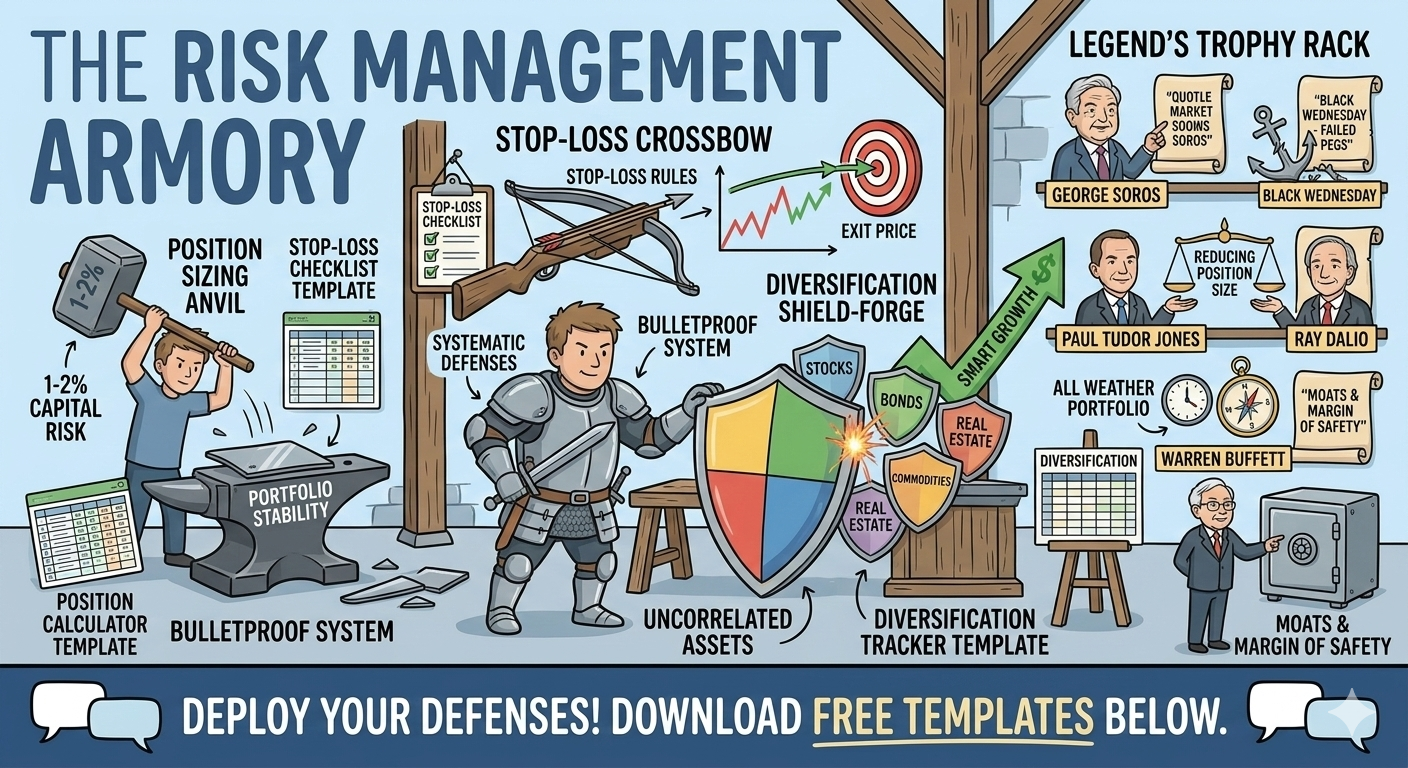
Position sizing is all about deciding how much money to put into each trade or investment. Mess this up, and one wrong call could crush your portfolio. The key rule? Never put more than 1-2% of your total capital at risk on any one move. This keeps losses small and helps you stay calm.
What We Can Learn from the Pros
Paul Tudor Jones: He nailed the 1987 Black Monday prediction and stresses cutting back when things are rough. "When I’m performing poorly, I keep reducing my position size. That way, I will be trading my smallest position size when my trading is at its worst." This helped him save his capital in tough times so he could jump on the upswings.
Ray Dalio: Running Bridgewater Associates, he uses a balanced risk approach across different assets to cut down on big drops. He says, "The essence of investment management is the management of risks, not the management of returns."
Your Step-by-Step Plan
Figure Out Your Risk Level: Take 1-2% of your whole portfolio. For a ₹1,00,00,000 account, that means ₹1,00,000 to ₹2,00,000 max risk per trade.
Pick Your Stop-Loss: Choose the price where you will bail if things go south (we will cover this more soon).
Work Out the Position Size: Try this formula: Position Size = (Risk Amount) / (Entry Price - Stop-Loss Price). For stocks, divide by the share price to find out how many shares.
Tweak for Market Swings: Grab tools like Average True Range (ATR) to adjust sizes in bumpy conditions.
Check In Often: After every trade, note it down and tweak based on how it went.
Free Template: Position Sizing Calculator
Pop this into a spreadsheet:
Cell A1: Total Capital (e.g., 10000000)
Cell A2: Risk % (e.g., 0.01 for 1%)
Cell A3: Entry Price
Cell A4: Stop-Loss Price
Cell A5: =A1*A2 / (A3-A4) // Position Size (in units)
This quick setup makes sure you never overdo it.
Stop-Loss Rules: Your Quick Way Out
A stop-loss is a set price where you automatically sell to limit your loss. It is the best way to enforce discipline and keep feelings out of it.
What We Can Learn from the Pros
George Soros: Back on Black Wednesday in 1992, Soros bet against the British pound with a huge position worth about ₹80,000 crore, making over ₹8,000 crore when the UK left the ERM. His win came from spotting the shaky fixed rates, backed by smart risks. But he played it safe with a plan to get out if needed. The takeaway? Huge moves need rock-solid stops to handle it if your idea flops.
Jesse Livermore: This early 1900s trader went broke a few times from weak stops at first, but got better later. He stressed, "Cut your losses quickly."
Your Step-by-Step Plan
Pick the Kind: Go for a hard stop (market order) if things move fast, or a trailing stop to secure profits as prices climb.
Where to Place It: Base it on chart levels (like below a support line) or swings (say, 2x ATR from where you entered).
Lock It In: Set the order right after you start the trade. Never push it further to give more wiggle room.
Add Time Limits: Get out if nothing happens in your set time (like 5 days).
Test It Back: Run it against old data to see if your rules hold up.
Free Template: Stop-Loss Checklist
Trade Idea: [Describe]
Entry Price: [Value]
Stop-Loss Price: [Value] (Reason: [Support level/ATR])
Potential Risk: [Calculate as % of capital]
Reward Target: [Aim for 2:1 risk-reward ratio]
Exit Trigger: [Price hit / Time expired]
Jot this down or save it digitally for each trade.
Diversification: Spreading Risk Smartly Without Cutting Gains
Diversification is not about grabbing a bit of everything. It is about picking assets that do not all move together, so they cushion blows.
What We Can Learn from the Pros
Warren Buffett: He focuses on top picks but spreads across sectors with strong edges. He notes, "Diversification is protection against ignorance," yet the best use it wisely.
Ray Dalio: His All Weather Portfolio mixes stocks, bonds, commodities, and inflation guards for any economy. "Diversify across uncorrelated assets to reduce risk."
Paul Tudor Jones: He hunts lopsided chances but spreads over big-picture bets to dodge total wipeouts.
Your Step-by-Step Plan
Check How They Link: Use charts to make sure assets do not copy each other.
Split It Up Wisely: Maybe 40% in stocks, 30% bonds, 15% commodities, 15% other stuff (tweak for your comfort).
Balance Every Quarter: Sell the hot ones, buy the slow ones to keep your mix steady.
Throw in Safety Nets: Use options or opposite bets for extra cover.
Watch Big Trends: Shift based on the economy (more bonds when things slow down).
Free Template: Diversification Tracker
Asset Class | Allocation % | Current Value | Target Value | Action Needed
Equities | 40 | [Input] | =Total*0.4 | [Buy/Sell]
Bonds | 30 | [Input] | =Total*0.3 | [Buy/Sell]
Etc.
Keep this table handy to stay on track.
Tying It All Up: From Ideas to Real Moves
To make a tough system, weave these pieces into one solid plan. Kick off easy: Test your rules on paper for a month, then go live with actual money. Think of Soros's big 1992 win. It was not chance. It was prep plus opportunity, with risks handled tight. Folks like Jones and Dalio win big because they see risk as a craft, not a roll of the dice.
If you are geared up to level your trading, connect with groups that push these ideas. Over at @arthalearn, we break down market skills with real, proven tips. What is your toughest risk spot? Drop it in the comments, and let us team up to get stronger.
Enjoyed this article?
ArthaLearn is more than articles. Log your trades, get AI-powered analysis, and track your improvement over time — built for Indian traders.
Free forever for trade logging. AI features start at ₹599/month.