Navigating Investments in Tough Times: Tips for the Indian Market
Discover how to make smart investment decisions amid global uncertainty and market volatility, tailored for the Indian context. Learn about behavioral biases, proven strategies like diversification and SIPs, and why education is key—plus, explore ArthaLearn for deeper insights.

Tough markets are where real investors are made. The discipline you build during drawdowns is what compounds during bull runs.
Hey there, fellow investor. In a world full of geopolitical shakes, economic dips, and surprises like pandemics, the Indian stock market can feel like a wild ride. Remember the 2008 crash when the Sensex dropped over 50 percent? Or the 2020 COVID plunge that hit the Nifty by 38 percent in weeks? Fast forward to 2026, and we're dealing with supply chain hiccups, inflation from global conflicts, and local issues like erratic monsoons. But here's the good news: those who stay calm, learn from the patterns, and apply smart strategies often come out ahead. This piece is all about building your knowledge on decision-making during fear and uncertainty. It shares practical lessons tailored for India to help you grow as an investor.
What's Behind Market Chaos in India?
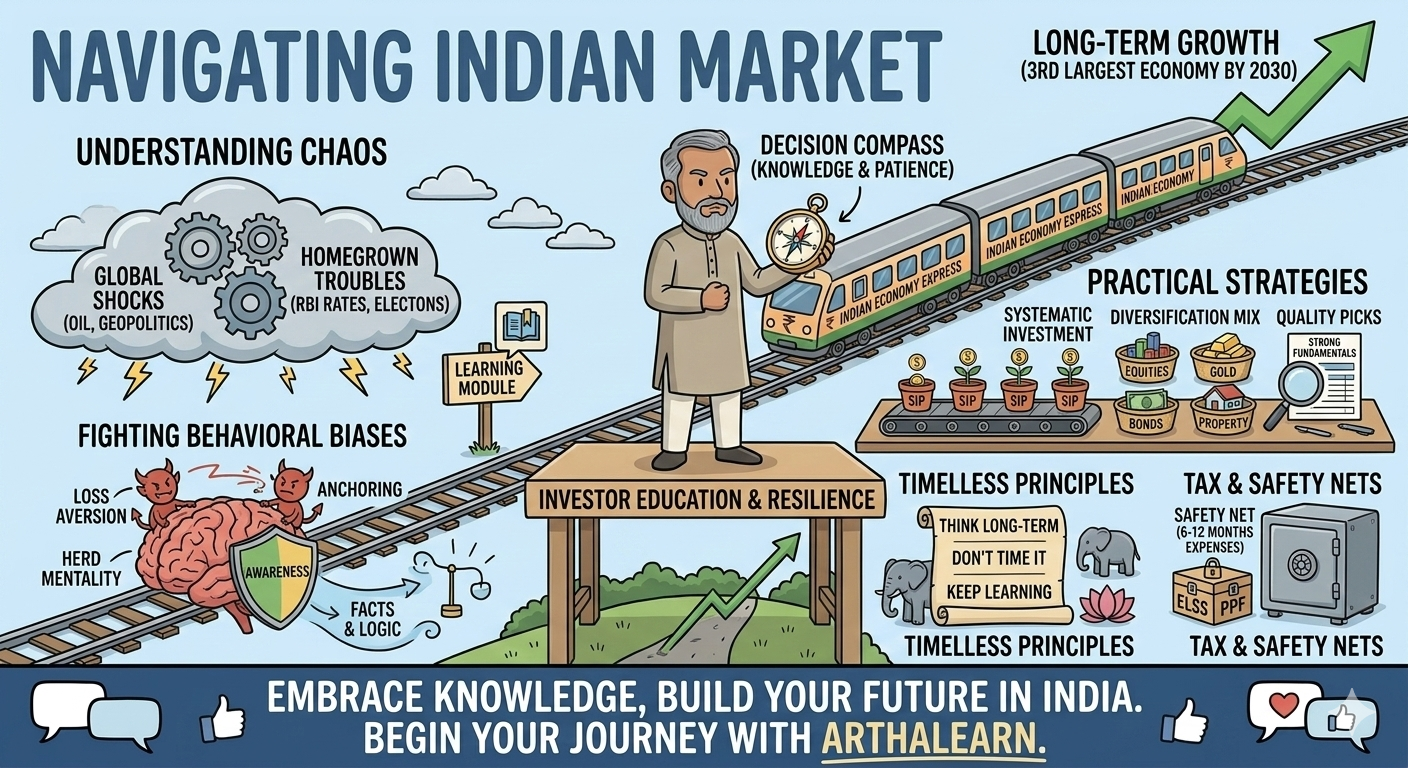
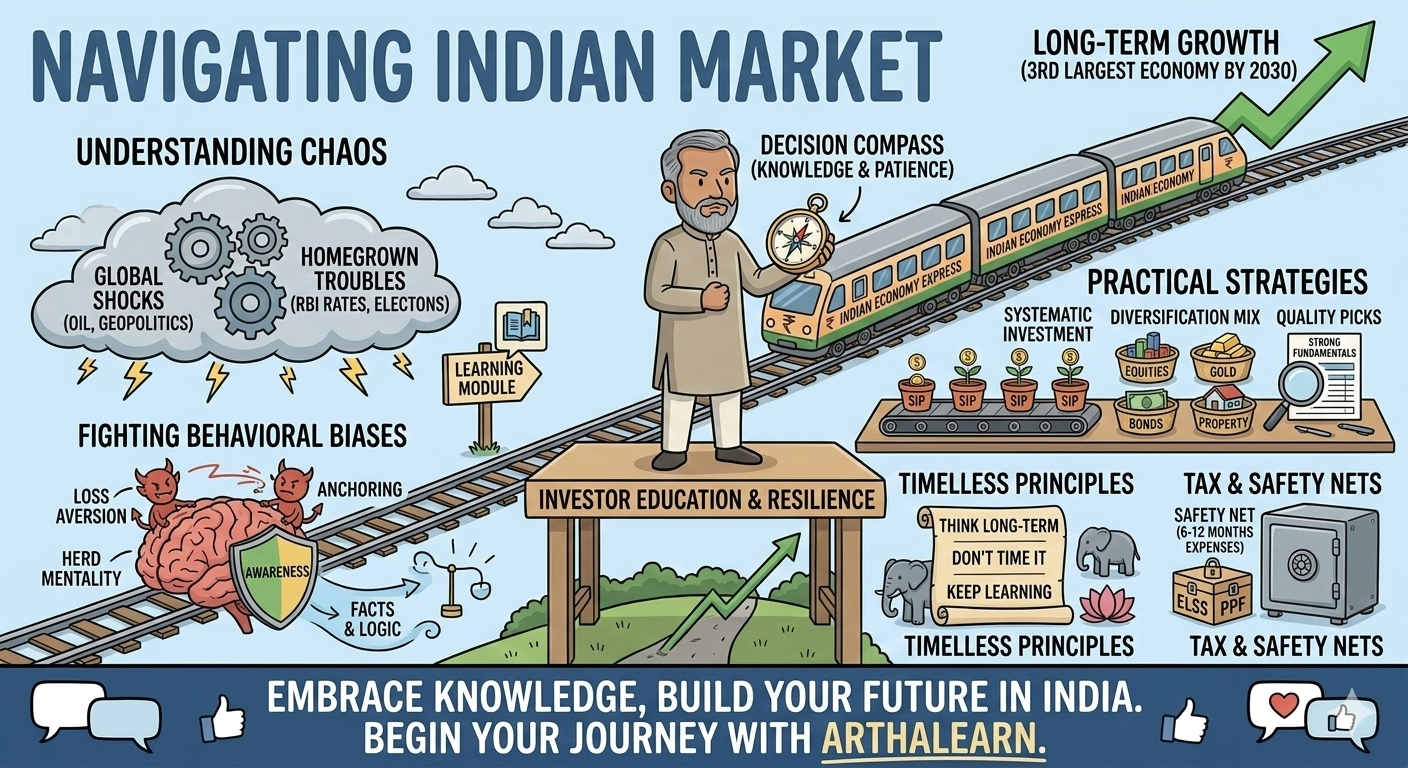
Market turmoil usually mixes global and homegrown troubles. On the world stage, things like the Russia-Ukraine war or US-China trade spats hike oil prices, shake the rupee, and scare off foreign cash. At home, RBI rate tweaks to fight inflation or election jitters add fuel to the fire. The rupee's slides make imports pricier, hitting sectors like IT and pharma hard.
Fear takes over in these moments. India's edge? A young population, digital boom, and pushes like Make in India keep us resilient. Learning about these factors helps shift you from panic to thoughtful planning. That's where education platforms like ArthaLearn come in, offering modules to decode market drivers.
Making Choices When Emotions Run High: Watch Out for Behavioral Biases
Uncertainty pits feelings against facts, and that's where behavioral finance shines a light on our common pitfalls. Loss aversion makes us hate losses twice as much as we love gains, so we often sell during dips like the 2022 recession fears, missing the Nifty's quick rebound. Herd mentality drives us to follow the crowd, leading to mass sells in events like 2016 demonetization or 2020 lockdowns. Confirmation bias tricks us into seeking only info that backs our views, ignoring red flags. Overconfidence pushes risky bets, like chasing hype in volatile assets during 2022-23 market swings. And anchoring bias keeps us stuck on past prices, making us hold losers too long or sell winners too soon.
The lesson? Awareness is your first defense. Fight back by building habits through learning:
Know your risk level: A young Mumbai pro can handle more equities; a Kerala retiree needs stability. Reflect on your own profile.
Get info wisely: Stick to reliable sources like NSE, BSE, RBI reports, or SEBI-registered advisors. Skip rumor mills and learn to spot bias.
Plan for worst cases: Test your portfolio against a 20 percent drop, a common Indian bear market scenario, to understand resilience.
As Warren Buffett puts it, be fearful when others are greedy, and vice versa. In 2020's lows, those who learned from history grabbed opportunities in undervalued sectors like banking and consumer goods, reaping rewards on recovery. ArthaLearn offers free tools and AI insights on these biases, complete with quizzes and real Indian case studies, to help you build better decision-making skills.
How to Steer Through the Markets: Lessons in Practice
Thriving means blending defense with smart moves, all while focusing on education. Here's how to apply key concepts:
Diversify Smartly: Spread across equities (via mutual funds or ETFs tracking Nifty/Sensex), bonds, gold (a solid hedge against rupee weakness), and property. Learn why gold performed well in 2022-23 inflation. It's about understanding asset correlations.
Go Systematic: Use rupee cost averaging with regular SIPs. This approach smoothed volatility in 2018-19, teaching the power of consistency over timing.
Pick Quality: Focus on companies with strong fundamentals like solid balance sheets and steady revenues. Study annual reports to spot these traits yourself.
Tax Smarts: Explore ELSS for Section 80C savings or PPF for secure, tax-free growth. In high-rate periods like 2023-24, debt options highlight the value of timing tax strategies.
Watch Big Picture: Track RBI rates, inflation, and reserves. A weak rupee might favor export-heavy sectors; inflation could boost everyday consumer plays. Learning macro basics sharpens your edge.
Build a Safety Net: Keep 6-12 months' expenses in liquid assets to avoid forced sells. This teaches discipline in cash management.
ArthaLearn's interactive tools let you simulate these strategies with Indian market data, turning theory into personal lessons.
Proven Investing Ideas for Rough Patches: Build Your Knowledge Base
These timeless principles, backed by Indian market history, are best learned through study and application:
Think Long Term: The Sensex has delivered over 15 percent CAGR since 1979, despite crashes. Patience is a skill. Short-term plays often fail, as seen in the 1992 scam era.
Balance Assets: Start with 60/40 equities to debt, adjust by age. Annual rebalancing, like buying low in 2020, teaches market cycles.
Spread Out: Diversification cushioned blows in 2008 by mixing sectors like banking with IT and energy. Experiment with model portfolios to grasp this.
Don't Time It: Time in the market wins. AMFI data shows SIPs outperforming lump sums in volatile times. Practice with calculators.
Keep Learning: Dive into books like "The Intelligent Investor" or Indian gems like "Coffee Can Investing." ArthaLearn curates reading lists and webinars to accelerate your growth.
These aren't quick fixes; they're building blocks for lifelong investing wisdom. They've transformed 1991 economic shocks into success stories for those who studied them.
Wrapping Up: Turn Chaos into Wins, and Keep Learning
Tough times are inevitable, but India's path to becoming the third-largest economy by 2030 offers huge potential. By focusing on education, taming biases, and applying these lessons, you can navigate dips and seize opportunities. Remember, markets reward the steady learner over the rushed gambler. Start building your skills today. ArthaLearn is India's trading journal and analytics platform designed for traders and Investors alike. It helps users build discipline by tracking, analyzing, and learning from trades, with features like AI-powered reviews, portfolio tracking, behavioral analytics, inflation planners, curated resource directories, and free tools such as calculators for position sizing, P&L, taxes, and more—all tailored for the Indian context. Your future self will thank you! Visit www.arthalearn.com for more information.
Enjoyed this article?
ArthaLearn is more than articles. Log your trades, get AI-powered analysis, and track your improvement over time — built for Indian traders.
Free forever for trade logging. AI features start at ₹599/month.